



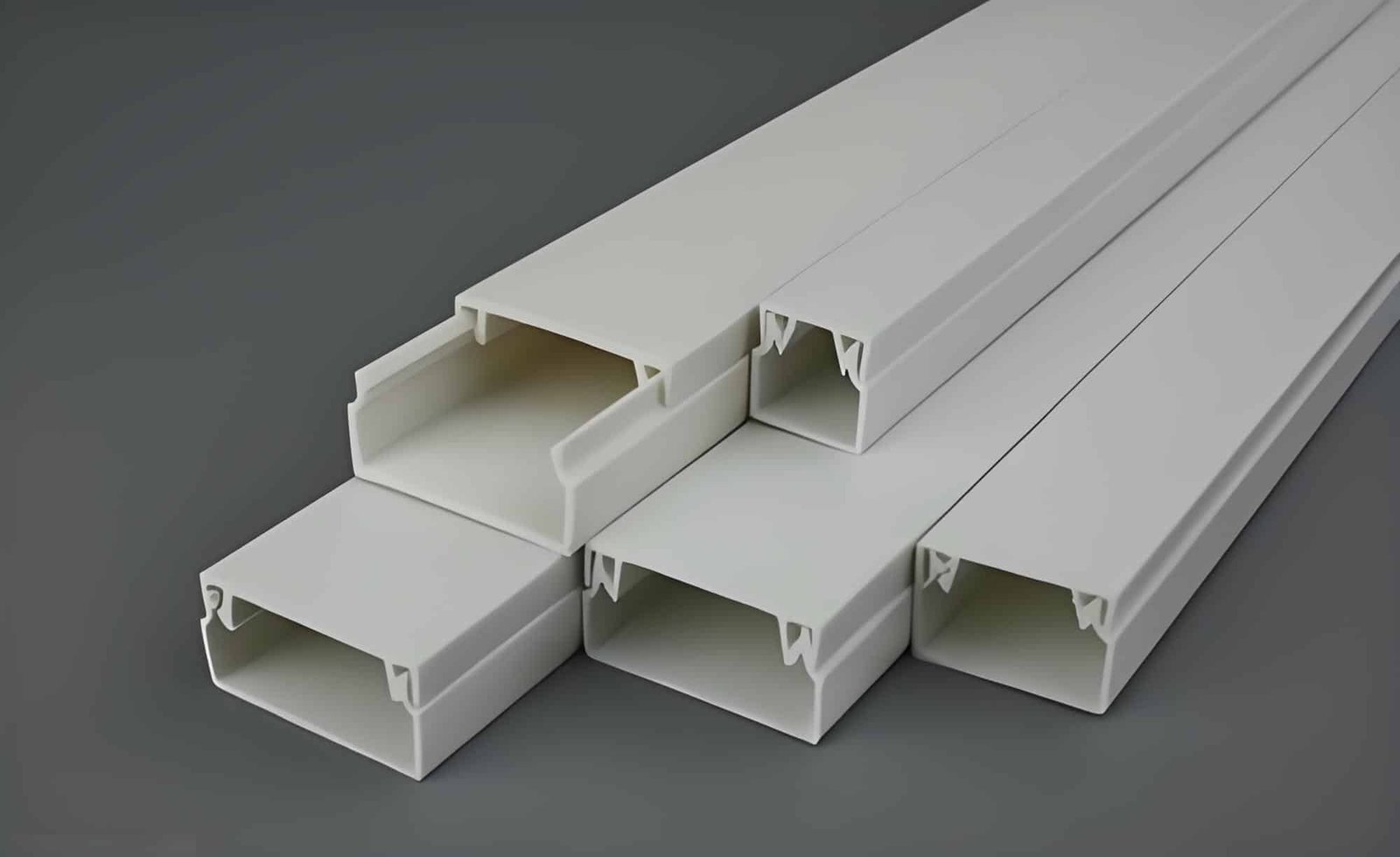
In modern commercial buildings, modular offices, data centers, hospitals, airports, schools, and industrial facilities, قنوات الكابلات has become an essential part of electrical and network infrastructure.
However, many procurement teams discover a serious problem after installation:
The first batch of قنوات كابلات PVC fits perfectly, but during large-scale installation, visible gaps begin to appear between trunking sections, covers no longer align correctly, and some joints require rework on-site.
In many cases, the root cause is not installation quality.
The real problem is dimensional tolerance.
For a 3-meter-long قنوات الكابلات profile, even a small dimensional deviation can become highly visible when hundreds or thousands of meters are installed together.
بصفتي محترفًا مصنع قنوات كابلات PVC with more than 20 years of extrusion experience, SW frequently receives questions such as:
- What dimensional tolerance is realistic for custom cable trunking?
- How much dimensional variation is acceptable?
- Why do some trunking systems develop gaps?
- How does die thermal expansion affect profile dimensions?
- Can a PVC cable trunking factory guarantee perfect dimensions?
- How can buyers specify tolerances correctly?
This article provides a practical engineering guide for buyers, project managers, designers, and procurement professionals seeking high-quality قنوات الكابلات systems.
Why Dimensional Accuracy Matters in Cable Trunking
Many buyers focus on:
- Material quality
- مقاومة للحريق
- Color consistency
- Impact strength
But dimensional accuracy often determines whether installation succeeds.
Poor dimensional control can cause:
- Visible gaps
- Uneven cover fit
- Misaligned joints
- تأخيرات في التركيب
- ارتفاع تكاليف العمالة
- شكاوى العملاء
For large modular office projects, tolerance control is often more important than material cost differences.
Why 3-Meter Cable Trunking Is More Challenging Than Short Profiles
A 100 mm sample can appear perfect.
A 3-meter profile presents completely different challenges.
As profile length increases:
- Cooling shrinkage accumulates
- Internal stress increases
- Straightness becomes harder to control
- Warpage becomes more visible
This is why experienced مصنعي قنوات كابلات PVC evaluate full-length profiles rather than short laboratory samples.
Understanding Dimensional Tolerance in Cable Trunking
Dimensional tolerance refers to the allowable deviation from the target dimension.
مثال:
Target width:
100.00 mm
Tolerance:
±0.30 mm
Acceptable range:
99.70 mm to 100.30 mm
The same principle applies to:
- Height
- سمك الجدار
- Cover dimensions
- Locking features
- Divider geometry
Why Perfect Dimensions Are Physically Impossible
Many buyers ask:
“Can the trunking be exactly 100.00 mm?”
The practical answer is no.
Every extrusion process contains natural variation caused by:
- Material flow
- Temperature changes
- Die expansion
- Cooling behavior
- Haul-off speed variation
The goal is not perfection.
The goal is predictable and controlled variation.


How Die Thermal Expansion Affects Cable Trunking Dimensions
One of the most overlooked causes of dimensional variation is die thermal expansion.
What Happens During Extrusion?
The extrusion die may operate at:
- 170°C
- 180°C
- 190°C
- 200°C
depending on the formulation.
Steel expands as temperature rises.
As the die heats up:
- Internal openings change slightly
- Flow characteristics shift
- Profile dimensions change
This is completely normal.
Why Startup Parts Are Often Different
The first production meters may not match later production.
Until thermal equilibrium is reached:
- Dimensions fluctuate
- Surface quality varies
- Shrinkage changes
احترافي مصانع قنوات كابلات PVC usually discard startup material before formal production begins.
The Relationship Between PVC Shrinkage and Final Dimensions
After leaving the die, molten PVC begins cooling immediately.
مع انخفاض درجة الحرارة:
- Molecular chains contract
- Profile dimensions shrink
- Internal stress develops
The final dimension is determined by:
Final Dimension = Die Dimension – Shrinkage
The challenge is that shrinkage is never perfectly uniform.
Why Cable Trunking Shrinks Unevenly
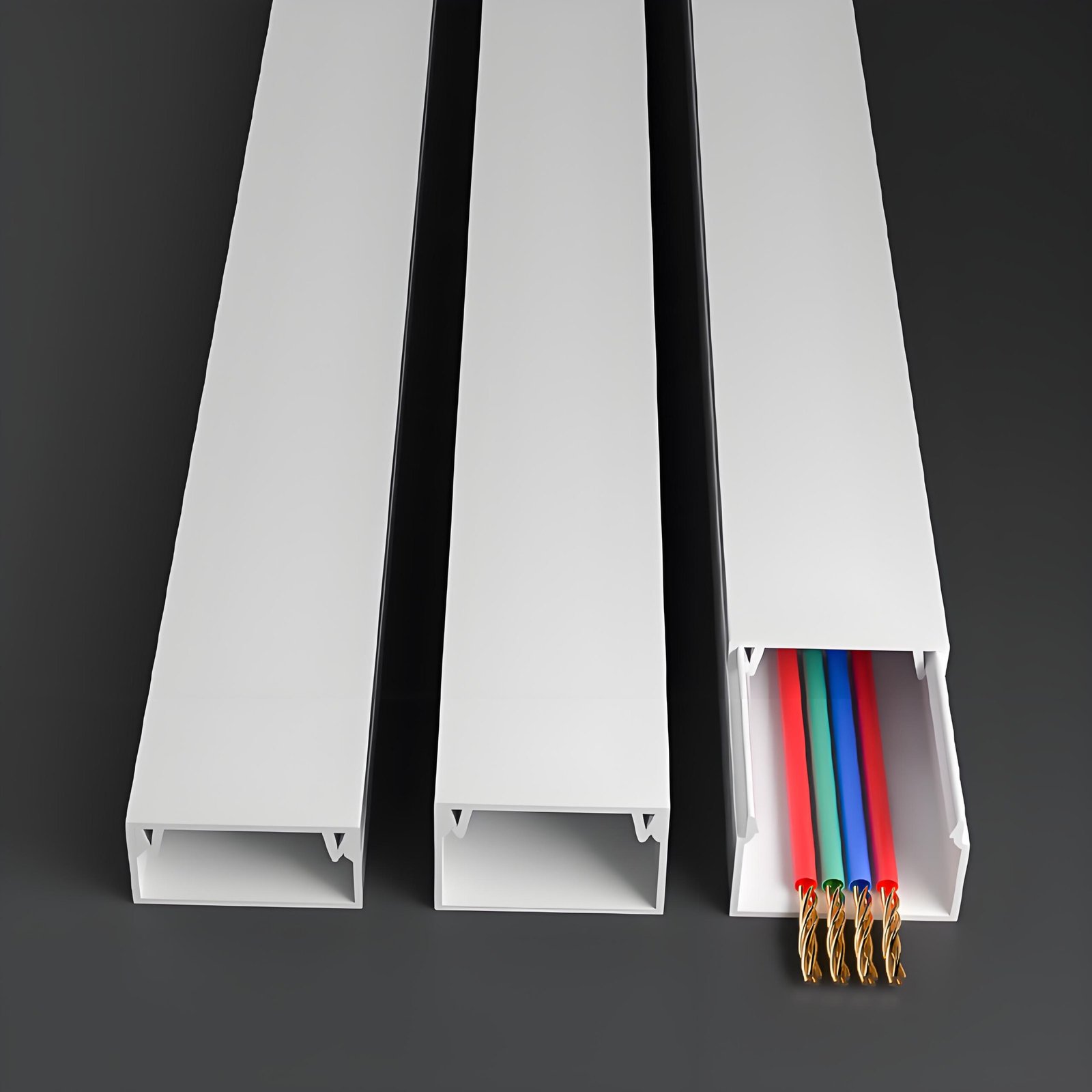
Unlike pipes, قنوات الكابلات profiles contain complex geometries.
ومن الأمثلة على ذلك:
- Side walls
- Internal partitions
- Snap-fit structures
- Cover locking systems
- Reinforcing ribs
Different sections cool at different rates.
This creates unequal shrinkage.
The result can be:
- Bowing
- Twisting
- Dimensional drift
What Dimensional Tolerances Are Realistic for PVC Cable Trunking?
The answer depends on profile size and application.
However, professional مصنعي قنوات كابلات PVC generally target:
عرض
±0.20 mm to ±0.50 mm
Height
±0.20 mm to ±0.50 mm
Wall Thickness
±0.10 mm to ±0.20 mm
Cover Fit Dimensions
±0.10 mm to ±0.20 mm
طول
±2 mm to ±5 mm per 3 meters
These values are considered realistic and achievable in mass production.
What Tolerance Can Modular Office Installations Accept?
For modular office projects, visual appearance becomes critical.
Most installers prefer:
Width tolerance:
±0.30 mm maximum
Height tolerance:
±0.30 mm maximum
Cover engagement dimensions:
±0.15 mm maximum
These limits help ensure seamless connections.
Why Cover Tolerance Is More Important Than Overall Width
Many buyers focus on overall profile dimensions.
However, the most critical feature is often the locking geometry.
If the cover dimensions vary by:
0.5 mm
problems may include:
- Loose lids
- تركيب صعب
- Lid popping open
محترف مصنع قنوات كابلات PVC prioritizes functional dimensions rather than only external dimensions.
The Hidden Impact of Calibration Systems
Calibration is the heart of dimensional control.
After exiting the die, the profile enters a vacuum calibration system.
The calibrator determines:
- شكل
- مقاس
- Straightness
- Surface finish
Poor calibration design causes:
- Inconsistent dimensions
- Twisting
- Cover mismatch
How Professional PVC Cable Trunking Factories Control Dimensions
At SW, dimensional control begins long before production.
Step 1: Tooling Simulation
Engineers predict:
- Material flow
- Shrinkage behavior
- Cooling distribution
before manufacturing the die.
Step 2: Thermal Compensation Design
The die is intentionally designed to compensate for:
- Thermal expansion
- Material shrinkage
This improves dimensional accuracy.
Step 3: Precision Calibration
Custom calibrators stabilize the profile immediately after extrusion.
Step 4: Automated Puller Control
Consistent haul-off speed prevents dimensional fluctuation.
Step 5: Continuous Inspection
Operators measure:
- عرض
- Height
- سمك الجدار
- Cover dimensions
throughout production.

Why Material Formulation Influences Tolerance
Many buyers assume dimensions depend only on tooling.
Actually, formulation plays a major role.
High Filler Content
Excessive calcium carbonate may cause:
- Uneven shrinkage
- Higher warpage
- Reduced dimensional stability
Recycled Material
Mixed recycled PVC often creates:
- Variable flow characteristics
- Inconsistent shrinkage
This increases dimensional variation.
Premium PVC Compounds
High-quality formulations provide:
- Stable melt flow
- Predictable cooling
- Better dimensional consistency
Why Long Profiles Need Straightness Specifications
For 3-meter قنوات الكابلات, straightness becomes critical.
Even if width and height are correct, a bowed profile creates installation issues.
Common straightness specifications include:
Maximum bow:
1–3 mm per meter
Maximum twist:
Less than 1 degree per meter
احترافي مصانع قنوات كابلات PVC monitor these values carefully.
Common Causes of Gaps in Large Modular Installations
Cause 1: Length Variation
Small length differences accumulate across long runs.
Cause 2: Width Drift
Profiles no longer align correctly.
Cause 3: Cover Shrinkage
Lids fail to match the base profile.
Cause 4: Warped Profiles
Twisted sections create visible joint gaps.
Cause 5: Mixed Production Batches
Different production runs may shrink differently.
How Buyers Should Specify Cable Trunking Tolerances
Instead of requesting:
“High quality cable trunking”
specify measurable requirements.
مثال:
Width:
100 mm ±0.30 mm
Height:
50 mm ±0.30 mm
Wall thickness:
2.0 mm ±0.15 mm
Length:
3000 mm ±3 mm
Straightness:
Maximum 2 mm/m
Cover engagement:
±0.15 mm
This eliminates ambiguity.
Should Buyers Request Tighter Tolerances?
Not always.
Extremely tight tolerances increase:
- Tooling cost
- Production cost
- Inspection cost
- Rejection rates
The optimal tolerance is the narrowest range that supports installation performance.
Future Trends in Precision Cable Trunking Manufacturing
The industry is moving toward:
- AI-assisted dimensional control
- Laser measurement systems
- Smart extrusion lines
- Real-time process monitoring
- محاكاة التوأم الرقمي
الريادة مصنعي قنوات كابلات PVC are increasingly adopting these technologies to improve consistency.

لماذا تُعتبر شركة SW شركةً موثوقةً لتصنيع قنوات كابلات PVC
With over 20 years of extrusion expertise, SW provides:
- Custom cable trunking design
- Precision extrusion tooling
- Tight tolerance control
- هندسة التركيبات المتقدمة
- Global OEM and ODM support
Our engineering team helps customers balance dimensional precision, manufacturing efficiency, and project cost.
professional PVC cable trunking manufacturers can achieve
For large-scale modular office installations, dimensional accuracy is one of the most important factors affecting installation quality.
A realistic tolerance strategy should consider:
- Die thermal expansion
- PVC shrinkage
- Calibration performance
- Straightness requirements
- Cover fit accuracy
For most high-quality projects, professional مصنعي قنوات كابلات PVC can achieve:
- Width and height tolerances of ±0.30 mm
- Cover engagement tolerances of ±0.15 mm
- Length tolerances of ±3 mm
- Excellent straightness control
The key is not demanding impossible perfection. The key is working with an experienced مصنع قنوات كابلات PVC that understands how to control every stage of the extrusion process to deliver consistent, installation-friendly قنوات الكابلات profiles across every production batch.
لدينا مصنع لأنابيب PVC يضم فريقاً من المهندسين المهرة على أتم الاستعداد لدعمكم في رحلة تطوير منتجاتكم، بدءاً من الفكرة والتصميم وصولاً إلى الإنتاج. يمكنكم التواصل معنا بحرية لأي استفسار أو فكرة تخص منتجكم، وسيقوم مهندسونا بالرد عليكم بعرض سعر في أسرع وقت ممكن. واتساب +86 188 2072 7151
من هو شووي؟
منذ عام 2006، تُعدّ شركة شووي مصنعًا متخصصًا في قطاعات البثق، مقرها في مقاطعة قوانغدونغ بالصين. يضم فريق العمل لدينا ما بين 51 و100 موظف. يلتزم مصنع شووي لبثق PVC بتصميم وإنتاج قطاعات البثق، مثل أنابيب PVC، وقنوات PE، وخطوط PVC الجانبية. منذ تأسيسها، حظيت الشركة بتقدير واسع في السوق وثقة عميقة من عملائها بفضل تصميمها المبتكر، وتقنياتها المتقنة، وسعيها الدؤوب نحو تحقيق أعلى معايير الجودة.
هل أنت مصنّع أم تاجر؟
نحن شركة صينية رائدة قطاعات بثق PVC نحن شركة مصنعة، ويقع مصنعنا في مدينة هويتشو. يمتد مصنعنا على مساحة 16,000 متر مربع، ويضم أكثر من 5 خطوط إنتاج آلية لقطاعات البثق، بطاقة إنتاجية سنوية تبلغ 30,000 طن، ونخدم أكثر من 500 عميل حول العالم. نرحب بزيارتكم لمصنعنا!
ما هي مجموعة منتجاتكم؟
نحن متخصصون في تصميم وإنتاج منتجات عالية الجودة ملامح البثق,مثل أنابيب PVC، ومقاطع ABS، وأغطية مصابيح PC، وخطوط PVC الجانبية، وقنوات PP، وقطاعات PE...
كم تستغرق عملية التطوير المخصصة؟
نحن ندعم منتجات البثق المخصصة. تتكون العملية المعتادة من 4 خطوات: تأكيد الطلب ← تصميم ثلاثي الأبعاد/إثبات ← شهادة اختبار ← الإنتاج بكميات كبيرة (دورة من 3 إلى 8 أسابيع).
هل لديك أي شهادات دولية؟
لقد حصلنا على شهادات ISO 9001 وCE وRoHS وSGS وغيرها، ونلتزم بالمعايير السائدة في أوروبا وأمريكا والشرق الأوسط وآسيا.