




When purchasing custom cable trunking, most buyers focus on dimensions, fire ratings, color, and price. However, one of the most important factors affecting both cost and performance is often overlooked:
Wall thickness.
The wall thickness of a cable trunking profile directly impacts:
- Material cost
- Shipping cost
- Structural strength
- Installation performance
- Lid retention
- Impact resistance
- Long-term durability
Many procurement teams automatically assume thicker is better.
Unfortunately, this assumption often leads to unnecessary expenses.
On the other hand, making the wall too thin can create serious problems:
- Cracking during installation
- Lid deformation
- Reduced cable load capacity
- Product rejection
- Warranty claims
Als professioneller Hersteller von PVC-Kabelkanälen with more than 20 years of extrusion experience, SW frequently helps customers optimize wall thickness to achieve the best balance between cost and performance.
We call this balance:
The Cable Trunking Goldilocks Zone
Not too thick.
Not too thin.
Just right.
This article explains how to determine the optimal wall thickness for custom PVC-Kabelkanäle, reduce logistics costs, and maintain structural integrity throughout the product lifecycle.
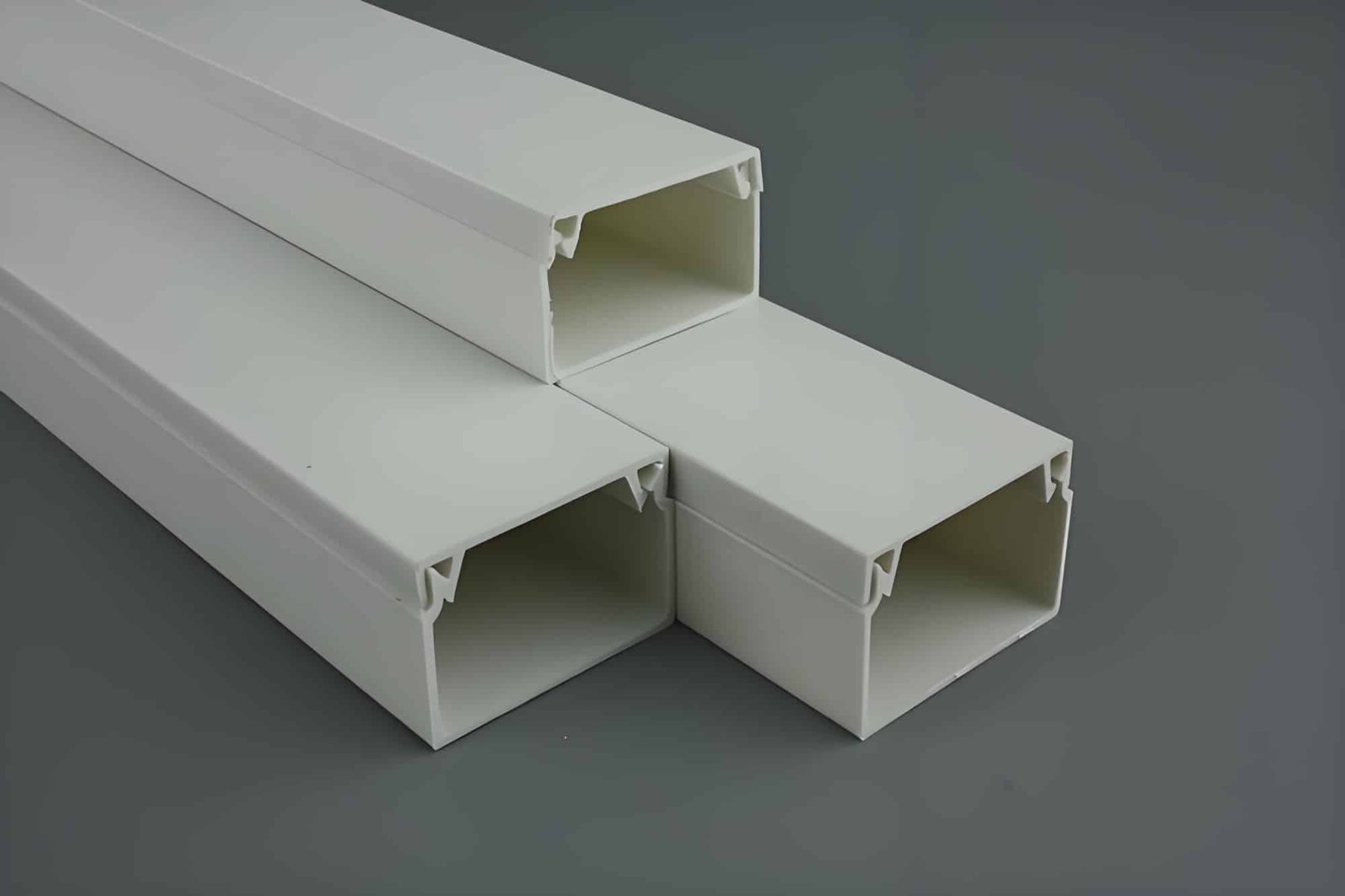
Why Wall Thickness Is One of the Biggest Cost Drivers in Cable Trunking
For most extrusion projects, raw materials account for a large percentage of production cost.
Typical cost breakdown:
- PVC resin
- Additives
- Tooling
- Labor
- Packaging
- Logistics
Among these factors, wall thickness directly affects material consumption.
A small increase in wall thickness often causes a surprisingly large increase in product weight.
How a Small Thickness Change Creates a Large Cost Difference
Consider a standard 100 × 50 mm PVC-Kabelkanäle profile.
Increasing wall thickness from:
2.0 mm → 2.5 mm
may increase material consumption by 20–30%.
That increase affects:
- Raw material cost
- Packaging weight
- Shipping volume
- Container loading efficiency
Across thousands of meters, the financial impact becomes significant.
Why Shipping Costs Are Becoming More Important
In many export markets, freight costs fluctuate dramatically.
Large cable trunking profiles often suffer from:
- High volumetric weight
- Low container utilization
- Increased handling costs
For international buyers, reducing profile weight by even 10–15% can generate substantial savings.
This is why many customers ask:
Can we make the cable trunking wall thinner?
The answer depends on the application.


Understanding Structural Requirements Before Choosing Wall Thickness
Before reducing wall thickness, engineers must evaluate how the cable trunking will be used.
Key questions include:
- How many cables will be installed?
- What is the cable weight?
- Indoor or outdoor installation?
- Horizontal or vertical mounting?
- Will installers frequently open the lid?
- What impact resistance is required?
Without these answers, wall thickness decisions become guesswork.
Why "Thicker Is Better" Is Often a Myth
Many buyers assume thicker walls automatically create a superior product.
This is not always true.
Excessively thick PVC-Kabelkanäle may introduce:
- Higher material costs
- Increased cooling time
- Greater shrinkage stress
- More warpage risk
- Difficult installation
Good engineering is not about maximum thickness.
It is about optimized thickness.
Understanding the Goldilocks Zone of Cable Trunking Wall Thickness
The ideal wall thickness is the point where:
Structural Performance = Maximum
Cost = Minimum
This balance varies by application.
The same wall thickness will not suit every project.
Typical Wall Thickness Ranges for PVC Cable Trunking
Most commercial PVC-Kabelkanäle products fall within these ranges:
Light-Duty Cable Trunking
1.0–1.5 mm
Applications:
- Small signal cables
- Home networking
- Security systems
Standard Commercial Cable Trunking
1.5–2.2 mm
Applications:
- Office buildings
- Schools
- Retail spaces
Heavy-Duty Cable Trunking
2.2–3.0 mm
Applications:
- Factories
- Data centers
- Industrial facilities
Extra Heavy-Duty Cable Trunking
3.0–5.0 mm
Applications:
- Infrastructure projects
- Utility installations
- High-load environments
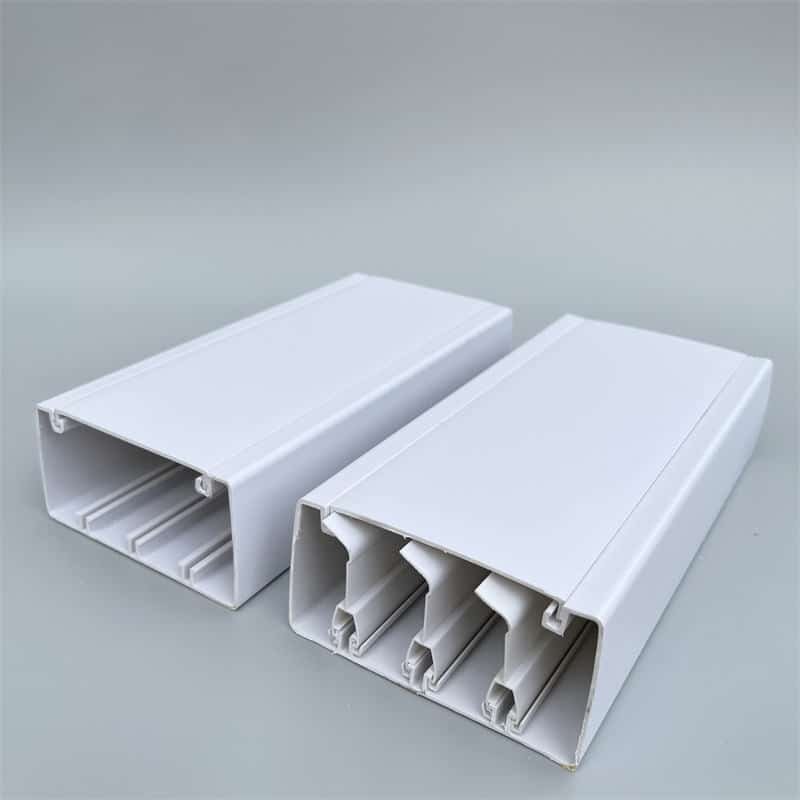
How Cable Weight Determines Wall Thickness
One of the most important factors is cable load.
The trunking must support:
- Cable weight
- Dynamic movement
- Installation forces
without excessive deflection.
Light Data Cables
Examples:
- Ethernet
- Fiber optic
- Communication wiring
These applications often allow thinner walls.
Heavy Power Cables
Examples:
- Industrial power circuits
- UPS systems
- High-current conductors
These applications require stronger profile structures.
Why Wall Thickness Alone Does Not Determine Strength
A common mistake is increasing thickness when the real solution is improving profile design.
Structural strength depends on:
- Wall thickness
- Rib geometry
- Corner design
- Material formulation
- Profile shape
A well-designed 2.0 mm profile may outperform a poorly designed 3.0 mm profile.
The Importance of Structural Ribs in Cable Trunking Design
Professional Hersteller von PVC-Kabelkanälen often use reinforcement ribs.
Benefits include:
- Increased stiffness
- Reduced material usage
- Better impact resistance
- Lower weight
Instead of adding thickness everywhere, ribs place material where it contributes most to strength.

Why Corner Geometry Matters
Corners experience high stress concentrations.
Sharp corners create:
- Crack initiation points
- Impact failure risks
- Stress accumulation
Rounded corners improve:
- Load distribution
- Haltbarkeit
- Long-term performance
This often allows thinner wall designs without sacrificing strength.
Material Selection Can Reduce Required Wall Thickness
Not all PVC compounds perform equally.
Standard PVC
Provides:
- Good rigidity
- Low cost
Impact-Modified PVC
Provides:
- Improved toughness
- Better low-temperature performance
- Higher impact resistance
Impact-modified compounds often allow thinner walls while maintaining performance.
How Lid Design Influences Wall Thickness Requirements
Many failures occur not in the base but in the cover.
The lid must:
- Snap securely
- Remain easy to open
- Resist deformation
If walls become too thin:
- Covers may bow
- Locking features may fail
- Snap-fit retention decreases
Ein Profi PVC-Kabelkanalfabrik evaluates both the base and lid as a complete system.
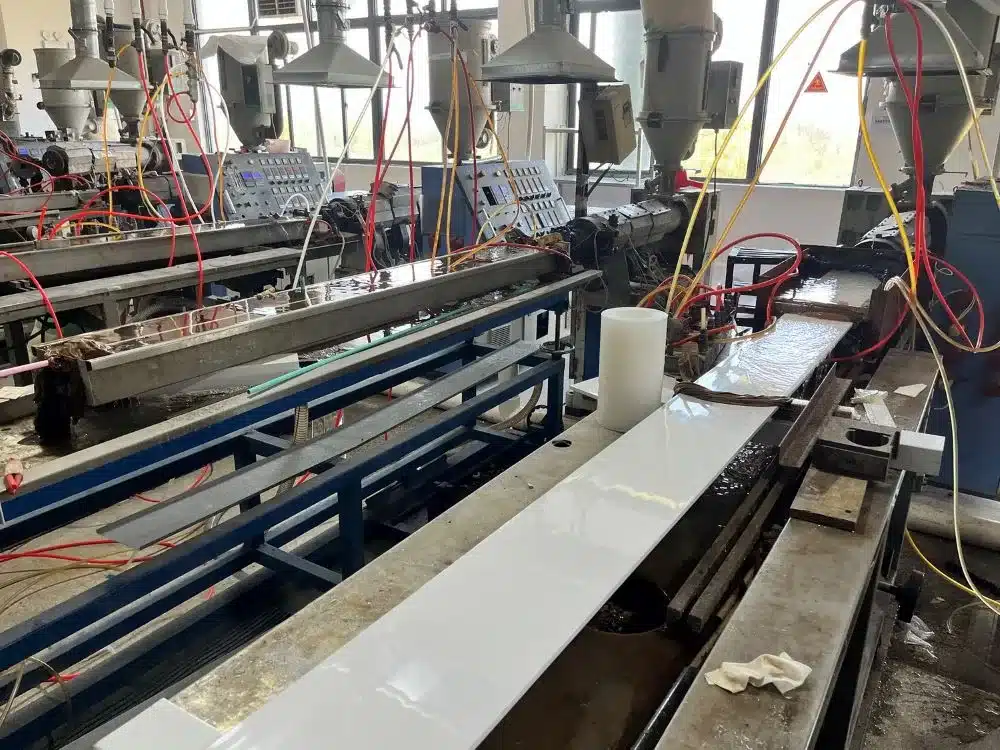
Shipping Optimization Through Wall Thickness Engineering
One of the biggest opportunities for savings comes from logistics optimization.
Example: Container Loading Analysis
Assume:
- 10,000 meters of cable trunking
- Wall thickness reduction from 2.5 mm to 2.0 mm
Potential benefits:
- Lower product weight
- Reduced freight charges
- Higher container efficiency
In many cases, the annual savings exceed the original tooling investment.
How Thin Is Too Thin?
This is the critical question.
A profile becomes too thin when it experiences:
- Excessive bending
- Cracking
- Lid disengagement
- Installation damage
- Long-term creep
The exact limit depends on:
- Profile size
- Material
- Environment
- Load conditions
Common Failure Modes of Thin-Wall Cable Trunking
Sidewall Collapse
Occurs when cable weight exceeds stiffness.
Cover Deformation
The lid no longer fits properly.
Mounting Screw Cracks
Fasteners create localized stress.
Corner Breakage
Impacts cause fractures.
Long-Term Sagging
PVC slowly deforms under constant load.
Why Data Centers Often Require Different Thickness Strategies
Modern data centers present unique challenges.
Characteristics include:
- High cable density
- Frequent maintenance
- Elevated temperatures
- Long service life
In these environments, the cheapest wall thickness may not be the most economical solution.
Durability becomes more important than material savings.
How SW Determines the Optimal Cable Trunking Wall Thickness
Als erfahrener Hersteller von PVC-Kabelkanälen, SW follows a structured engineering process.
Step 1: Define Load Conditions
We evaluate:
- Cable weight
- Installation method
- Environmental conditions
Step 2: Analyze Profile Geometry
Our engineers optimize:
- Rib placement
- Corner radii
- Lid structure
before increasing wall thickness.
Step 3: Material Evaluation
We select the most suitable PVC formulation.
Options include:
- Standard rigid PVC
- Impact-modified PVC
- Flame-retardant PVC
- Custom compounds
Step 4: Prototype Testing
Sample profiles undergo:
- Impact testing
- Load testing
- Lid retention testing
- Deflection analysis
Step 5: Cost Optimization
We identify the lowest-cost design that still satisfies performance requirements.
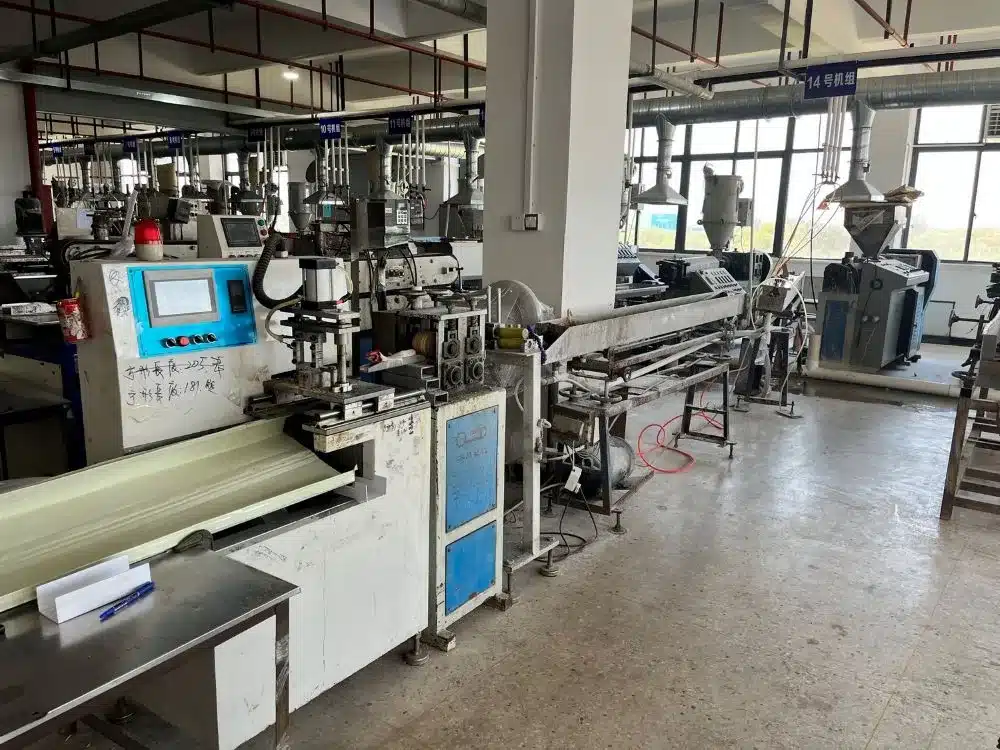
What Wall Thickness Do Buyers Usually Accept?
Although every project differs, many commercial projects accept:
Small Trunking (25×25 mm)
1.2–1.8 mm
Medium Trunking (50×50 mm)
1.5–2.2 mm
Large Trunking (100×50 mm)
2.0–3.0 mm
Data Center Trunking
2.5–3.5 mm
These ranges typically provide a good balance between strength and cost.
Common Buyer Mistakes When Specifying Cable Trunking
Mistake 1: Choosing Thickness Based Only on Price
Lowest cost often results in higher failure rates.
Mistake 2: Copying Competitor Specifications
Different projects require different solutions.
Mistake 3: Ignoring Shipping Costs
Freight savings can outweigh small material cost differences.
Mistake 4: Overengineering the Product
Excessive thickness increases costs without meaningful benefits.
Future Trends in Cable Trunking Design
Leading Hersteller von PVC-Kabelkanälen are increasingly using:
- Finite Element Analysis (FEA)
- Digital twin simulations
- Lightweight structural designs
- High-performance PVC compounds
- Material optimization software
The future is not thicker trunking.
The future is smarter trunking.

Why SW Is a Trusted PVC Cable Trunking Manufacturer
With over 20 years of extrusion experience, SW helps customers develop custom cable trunking solutions that balance:
- Structural performance
- Material efficiency
- Freight optimization
- Installation convenience
- Long-term durability
Our engineering team works closely with customers to identify the true Goldilocks Zone for each project.
The ideal cable trunking wall thickness
The ideal cable trunking wall thickness is not the thickest possible design and not the thinnest possible design.
The best solution is the Goldilocks Zone where:
- Material consumption is minimized
- Shipping costs are reduced
- Structural integrity is maintained
- Installation remains easy
- Long-term reliability is protected
For most projects, intelligent profile design, optimized PVC formulations, and proper structural reinforcement provide better results than simply adding more material.
By working with an experienced Hersteller von PVC-Kabelkanälen such as SW, buyers can achieve the optimal balance between cost, performance, and durability—ensuring that every meter of cable trunking delivers maximum value throughout its service life.
FAQs:cable trunking wall thickness
Q1: What is the ideal wall thickness for PVC cable trunking?
Most commercial PVC cable trunking products use wall thicknesses between 1.5 mm and 3.0 mm depending on cable load and installation requirements.
Q2: Does thicker cable trunking always perform better?
No. Excessive thickness increases material cost, shipping cost, cooling stress, and warpage risk. Optimized structural design often provides better performance.
Q3: How can cable trunking manufacturers reduce shipping costs?
By optimizing wall thickness, adding reinforcement ribs, improving profile geometry, and selecting suitable PVC compounds.
Q4: What causes thin-wall cable trunking to fail?
Common causes include insufficient stiffness, excessive cable weight, poor profile design, inadequate impact resistance, and weak lid locking structures.
Q5: What is the Goldilocks Zone for cable trunking wall thickness?
The Goldilocks Zone is the optimal balance between material cost, shipping efficiency, and structural performance where the trunking is neither too thick nor too thin.
Wir verfügen über ein Werk für PVC-Rohre mit erfahrenen Ingenieuren, die Sie bei der Produktentwicklung – von der ersten Idee bis zur Serienproduktion – unterstützen. Kontaktieren Sie uns gerne bei Fragen zu Ihrem Produkt. Unsere Ingenieure erstellen Ihnen umgehend ein Angebot. WhatsApp +86 188 2072 7151
Wer ist S oder Wei?
Seit 2006 ist Shuowei ein professioneller Hersteller von Extrusionsprofilen mit Sitz in Guangdong, China. Unser Team besteht aus 51 bis 100 Mitarbeitern. Die Shuowei PVC-Extrusionsfabrik hat sich auf die Entwicklung und Produktion von Extrusionsprofilen wie PVC-Rohren, PE-Kabelkanälen und PVC-Sockelleisten spezialisiert. Seit unserer Gründung haben wir uns durch innovatives Design, ausgereifte Technologie und unser kompromissloses Qualitätsstreben die breite Anerkennung des Marktes und das tiefe Vertrauen unserer Kunden erworben.
Sind Sie ein Hersteller oder ein Händler?
Wir sind ein chinesisches Top-Unternehmen PVC-Extrusionsprofile Unser Werk befindet sich in Huizhou. Es verfügt über eine 16.000 m² große Produktionsfläche, mehr als fünf automatisierte Extrusionsprofil-Produktionslinien, eine jährliche Produktionskapazität von 30.000 Tonnen und beliefert über 500 Kunden weltweit. Besuchen Sie uns!
Welche Produkte bieten Sie an?
Wir sind spezialisiert auf die Entwicklung und Produktion von hochwertigen Produkten. Extrusionsprofile,wie beispielsweise PVC-Rohre, ABS-Profile, PC-Lampenschirme, PVC-Sockelleisten, PP-Kabelkanäle, PE-Profile…
Wie lange dauert der Prozess der kundenspezifischen Entwicklung?
Wir unterstützen kundenspezifische Extrusionsprodukte. Der übliche Prozess umfasst 4 Schritte: Bedarfsbestätigung → 3D-Design/Proofing → Testzertifizierung → Serienproduktion (Zyklus 3-8 Wochen).
Besitzen Sie internationale Zertifizierungen?
Wir haben die Zertifizierungen ISO 9001, CE, RoHS, SGS und weitere erhalten und erfüllen die gängigen Standards in Europa, Amerika, dem Nahen Osten und Asien.