


In Parts 1 and 2, we explored SW’s core strengths in engineering design, material technology, structural innovation, simulation, tooling, quality assurance, and multi-industry applications. Part1:<Advanced Plastic Extrusion Design Capabilities at SW-Part 1>,Part 2:<Advanced Plastic Extrusion Design Capabilities at SW-Part 2>
Part 3 expands the knowledge base with more advanced design frameworks, selection criteria, engineering rules, and additional cross-industry case studies, concluding with a powerful value proposition for SW as a leading Hersteller von Kunststoffextrusionen.

22. Plastic Extrusion Material Selection Framework (Engineering-Level)
Selecting the correct material is essential for any custom plastic extrusion project. Material choice impacts:
Strength
Flexibilität
Thermal stability
Chemical resistance
UV resistance
Food safety
Medical compatibility
Appearance
Kosten
SW uses a structured Material Decision Matrix when guiding customers.
22.1 Decision Criterion A — Mechanical Requirements
High strength / structural use:
PC
ABS
PA (Nylon)
PP (glass-filled)
Flexible / resilient use:
TPE
TPU
Soft PVC
Impact resistance:
PC
ABS
PE
Wear resistance:
PA
POM
22.2 Decision Criterion B — Thermal Requirements
High temperature (100–140°C):
PC
PA66
PPO
Medium temperature (60–100°C):
ABS
PP
Low temperature flexibility:
PE
TPE
22.3 Decision Criterion C — Chemical Resistance
Acids / Alkalis:
PP
PE
PVDF
Solvents / oils:
PA
PPO
TPU
Medical-grade sterilization:
PC
PP (autoclave compatible)
Medical PVC
22.4 Decision Criterion D — Environment Exposure
Outdoor UV resistance:
ASA
PVC (add UV stabilizers)
PC (UV coated)
Water exposure:
PE
PP
PVC
Salt spray resistance:
ASA
PVC
PP
22.5 Decision Criterion E — Cost Efficiency
Low-cost options:
PE
PP
PVC
Mid-range:
ABS
PMMA
High-performance:
PC
PPO
PA engineering grades
SW guides clients through this matrix to ensure the extrusion material is the best balance of performance, cost, and manufacturability.
23. Engineering Checklist for Designing Custom Plastic Extrusion Profiles
When designing custom profiles, SW engineers follow a strict checklist to avoid common structural, tolerance, or manufacturing issues.
23.1 Wall Thickness Rules
Minimum recommended wall thickness: 0.8–1.2 mm, depending on material
Avoid abrupt thickness transitions (max recommended change: 20–30%)
Thick areas cause sink marks and cooling distortion
23.2 Hollow Chambers and Reinforcing Ribs
Chamber walls must be evenly spaced
Rib thickness should be 60–80% of wall thickness
Rib end radius must avoid sharp corners
Multi-chamber designs must support consistent cooling
23.3 Snap-Fit and Joint Design
Avoid stress concentration
Maintain material-specific deflection limits
Provide adequate insertion chamfers
Consider long-term fatigue cycles
23.4 Dimensional Tolerance Planning
Plastic extrusion tolerances vary by:
Profile width
Material shrinkage
Cooling behavior
Puller speed
Extrusion speed
SW typically delivers precision of:
±0.1 mm for small parts
±0.15–0.3 mm for larger profiles
23.5 Aesthetic Requirements
For visible components:
Texture must match tooling polish requirements
Avoid visual defects such as flow lines or weld marks
Color-matching must maintain ΔE < 1.0
23.6 Assembly Compatibility
All extrusions must account for:
Fit with metal components
Screw insertion points
Adhesive bonding surfaces
Ultrasonic welding zones

Chinesische Fabrik: OEM-PVC-Extrusionsprofile und ABS-Kunststoffprofile

Großhandel mit OEM-PVC-Extrusionsprofilen und Kunststoffprofilen ab Werk

Hersteller von PVC-Extrusionsprofilen und kundenspezifischen Kunststoffprofilen

Hersteller von PVC-Extrusionsprofilen – OEM-PVC-Profile
24. Case Study D: Large-Scale Extrusion for Outdoor Infrastructure
Client: Global fencing and decking manufacturer
Material: ASA/ABS co-extrusion
Product: Outdoor decking trim profiles
Profile Type: Large hollow chamber, reinforced structure
Challenges
Must withstand 10+ years of UV exposure
Must endure temperature swings from -30°C to 50°C
Profile must resist cracking, chalking, or fading
Dimensional precision required for assembly
Large cross-section increases risk of warping
SW’s Engineering Solutions
ASA weather-resistant cap layer
ABS structural core for stiffness
Multi-chamber cooling design
Large-format calibrator with 5-axis cooling control
Tooling with high-flow equalization channels
Ergebnisse
UV resistance validated to ASTM G154
Shape retention >98% after thermal cycling
High mechanical stiffness with low material weight
Color uniformity maintained for over 5 years in field tests
25. Case Study E: High-Precision Extrusion for Automotive Interior Components
Client: European automotive brand
Material: PC/ABS flame-retardant blend
Product: Instrument panel and decorative trim
Requirements
Smooth surface finish for visible interior parts
Tight tolerances to ensure perfect assembly
Flame retardancy UL94 V0
Resistance to chemical cleaners
Zero warpage over long profiles
SW’s Extrusion Approach
PC/ABS formulation optimized for stiffness and flow
Multi-zone temperature control
Anti-warping vacuum calibration system
High-gloss and matte co-extruded surfaces
Automated surface inspection
Outcome
High-end automotive aesthetic
Perfect alignment with adjacent components
No deformation during assembly
Passed all OEM chemical exposure tests

26. Case Study F: Precision Medical Tubing and Profile Extrusion
Client: Medical respiratory device manufacturer
Material: Medical-grade PVC + optional TPE sections
Product: Transparent tubing + flexible sealing profiles
Challenges
Must be biocompatible (ISO 10993)
Must have smooth inner surface to reduce turbulence
Must withstand disinfectant and sterilization
Must maintain ±0.05 mm tolerances
SW’s Solution
ISO 13485 controlled manufacturing
Laser online diameter measurement
High-clarity PVC formula
Smooth-bore mandrel extrusion
Low-particulate handling procedures
Ergebnisse
FDA/ISO compliant
Zero internal flow irregularities
Excellent transparency
Success in global clinical device markets
27. Jointing, Bonding, and Assembly Techniques for Plastic Extrusion
Extruded plastics can be assembled using several joining methods depending on material type.
27.1 Solvent Bonding
Works well with:
PVC
ABS
PMMA
Creates chemically fused joints with no mechanical fasteners.
27.2 Ultrasonic Welding
Suitable for:
PC
ABS
PP
PA
Ensures fast and strong assembly.
27.3 Mechanical Fastening
Used when disassembly is required:
Snap-fits
Clips
Screws (with metal inserts)
Sliding rails
27.4 Adhesive Bonding
Used for multi-material or dissimilar joints:
Epoxy
PU adhesive
Silicone rubber
SW provides bonding-strength testing for all assemblies.
28. Common Failure Modes in Plastic Extrusion and Preventive Engineering
Understanding failure modes ensures long product life cycles.
28.1 Warping and Dimensional Distortion
Causes:
Unbalanced cooling
Poor tooling design
Incorrect haul-off speed
Prevention at SW:
Flow simulation
Custom calibrator design
Servo-controlled puller
28.2 Surface Defects (Streaks, Lines, Bubbles)
Causes:
Moisture
Impurities in resin
Temperature imbalance
Prevention:
Resin drying
Inline filtering
Multi-zone temperature adjustment
28.3 Brittle Fracture or Cracking
Causes:
Incorrect material selection
UV-Strahlung
Over-stressing thin walls
Prevention:
Material optimization
UV-resistant additives
Rib and chamber reinforcement
28.4 Adhesion / Snap-Fit Failure
Causes:
Stress concentration
Wrong geometry
Material fatigue
Prevention:
FEA analysis
Radiused corners
Fatigue testing
29. Environmental & Regulatory Compliance for Plastic Extrusion
SW ensures that all extruded products comply with global regulations:
ROHS (Restriction of hazardous substances)
REACH (Chemical safety)
UL94 (Flammability)
FDA/ISO (Medical grade)
ASTM/ISO standards (Mechanical + environmental)
This makes SW a suitable partner for:
EU customers
North American clients
Medical industries
Automotive OEMs
Electronics manufacturers
30. How SW Collaborates with Clients: End-to-End Engineering Service Workflow
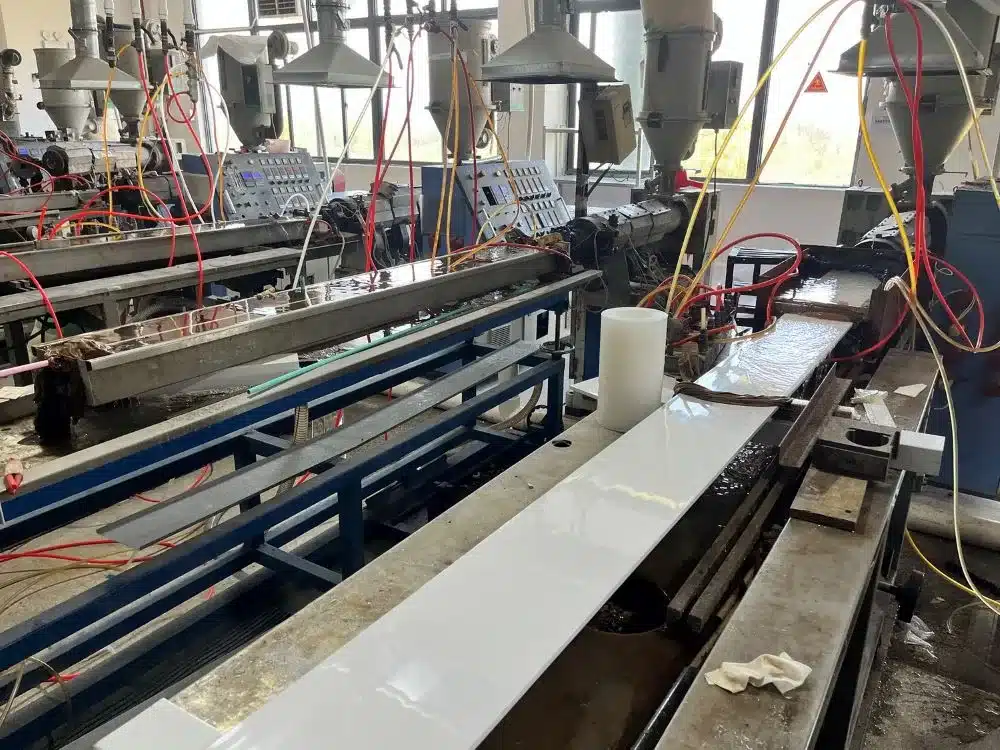
30.1 Step 1 — Requirement Analysis
Understanding function, environment, tolerances, material constraints.
30.2 Step 2 — Material and Structure Proposal
SW provides comparative reports and recommended designs.
30.3 Step 3 — 3D Modeling and Simulation
Flow simulation
FEA analysis
Thermal prediction
30.4 Step 4 — Tooling Development
High-precision dies + calibrators
Rapid modification cycle
30.5 Step 5 — Sample Production
Small-batch test runs
Dimensional inspection
30.6 Step 6 — Mass Production
Automated extrusion lines
Strict SPC control
30.7 Step 7 — Quality Testing
Mechanical testing
Environment testing
Surface inspection
30.8 Step 8 — Packaging & Logistics
Custom packaging
International shipping
Batch documentation
This full workflow is one of SW’s key advantages as a professional Kunststoffextrusionsfabrik.
31. Why SW Is the Ideal Global Plastic Extrusion Manufacturer
SW is not just a supplier—we are a global engineering partner for brands that demand excellence.
✔ 20+ years of specialty extrusion experience
✔ Full engineering design & simulation
✔ In-house tooling for faster development
✔ 40+ industrial-grade materials
✔ Global export and regulatory compliance
✔ Flexible low-volume and high-volume capacity
✔ Industry-focused solutions (medical, automotive, electronics, construction, etc.)
SW provides end-to-end engineering, not just extrusion.
32. Conclusion — The Future of Plastic Extrusion and SW’s Commitment to Innovation
Kunststoffextrusion will continue to grow in advanced industries such as automotive electrification, medical devices, smart electronics, renewable energy, robotics, and aerospace. Market demand is shifting toward:
Lightweight structural components
High-performance engineered polymers
Multi-material hybrid extrusions
Sustainable recycled composites
Smart functional extrusions with built-in electronics
SW is investing heavily in:
New materials R&D
AI-driven extrusion control
Digital quality systems
Sustainable manufacturing
Global supply chain optimization
Als führender plastic extrusion manufacturer, SW is ready to support global clients with engineering-driven, custom-built, high-performance extruded solutions.
Wir verfügen über ein Werk für PVC-Rohre mit erfahrenen Ingenieuren, die Sie bei der Produktentwicklung – von der ersten Idee bis zur Serienproduktion – unterstützen. Kontaktieren Sie uns gerne bei Fragen zu Ihrem Produkt. Unsere Ingenieure erstellen Ihnen umgehend ein Angebot. WhatsApp +86 188 2072 7151
Wer ist S oder Wei?
Seit 2006 ist Shuowei ein professioneller Hersteller von Extrusionsprofilen mit Sitz in Guangdong, China. Unser Team besteht aus 51 bis 100 Mitarbeitern. Die Shuowei PVC-Extrusionsfabrik hat sich auf die Entwicklung und Produktion von Extrusionsprofilen wie PVC-Rohren, PE-Kabelkanälen und PVC-Sockelleisten spezialisiert. Seit unserer Gründung haben wir uns durch innovatives Design, ausgereifte Technologie und unser kompromissloses Qualitätsstreben die breite Anerkennung des Marktes und das tiefe Vertrauen unserer Kunden erworben.
Sind Sie ein Hersteller oder ein Händler?
Wir sind ein chinesisches Top-Unternehmen PVC-Extrusionsprofile Unser Werk befindet sich in Huizhou. Es verfügt über eine 16.000 m² große Produktionsfläche, mehr als fünf automatisierte Extrusionsprofil-Produktionslinien, eine jährliche Produktionskapazität von 30.000 Tonnen und beliefert über 500 Kunden weltweit. Besuchen Sie uns!
Welche Produkte bieten Sie an?
Wir sind spezialisiert auf die Entwicklung und Produktion von hochwertigen Produkten. Extrusionsprofile,wie beispielsweise PVC-Rohre, ABS-Profile, PC-Lampenschirme, PVC-Sockelleisten, PP-Kabelkanäle, PE-Profile…
Wie lange dauert der Prozess der kundenspezifischen Entwicklung?
Wir unterstützen kundenspezifische Extrusionsprodukte. Der übliche Prozess umfasst 4 Schritte: Bedarfsbestätigung → 3D-Design/Proofing → Testzertifizierung → Serienproduktion (Zyklus 3-8 Wochen).
Besitzen Sie internationale Zertifizierungen?
Wir haben die Zertifizierungen ISO 9001, CE, RoHS, SGS und weitere erhalten und erfüllen die gängigen Standards in Europa, Amerika, dem Nahen Osten und Asien.