




Why Cable Trunking Sizes and Materials Matter
In modern electrical, data, and building infrastructure systems, cable trunking plays a critical role in organizing, protecting, and managing cables. Selecting the correct cable trunking sizes and materials is essential for ensuring electrical safety, installation efficiency, future expandability, and long-term durability.
As a professional plastic extrusion factory with more than 20 years of experience, SUDOESTE has manufactured and customized cable trunking systems for residential, commercial, industrial, and infrastructure projects across global markets. This article provides a comprehensive technical overview of cable trunking sizes and materials, helping engineers, installers, contractors, and distributors make informed decisions.

1. What Is Cable Trunking? Functional and Structural Overview
Canaletas para cables is an enclosed system used to route, protect, and organize electrical wires, data cables, and communication lines. From an engineering perspective, cable trunking serves several core functions:
Mechanical protection of cables
Electrical insulation and safety
Cable organization and separation
Aesthetic concealment
Simplified maintenance and upgrades
A well-designed cable trunking system depends heavily on correct cable trunking sizes y appropriate material selection.
2. Why Cable Trunking Sizes Are Critical in System Design
Selecting incorrect cable trunking sizes can lead to multiple issues:
Cable overcrowding and overheating
Difficulty during installation
Limited future cable expansion
Increased maintenance costs
Non-compliance with electrical standards
Professional cable trunking manufacturers like SUDOESTE always begin projects by evaluating cable quantity, cable diameter, bending radius, and installation environment before defining the correct cable trunking sizes.
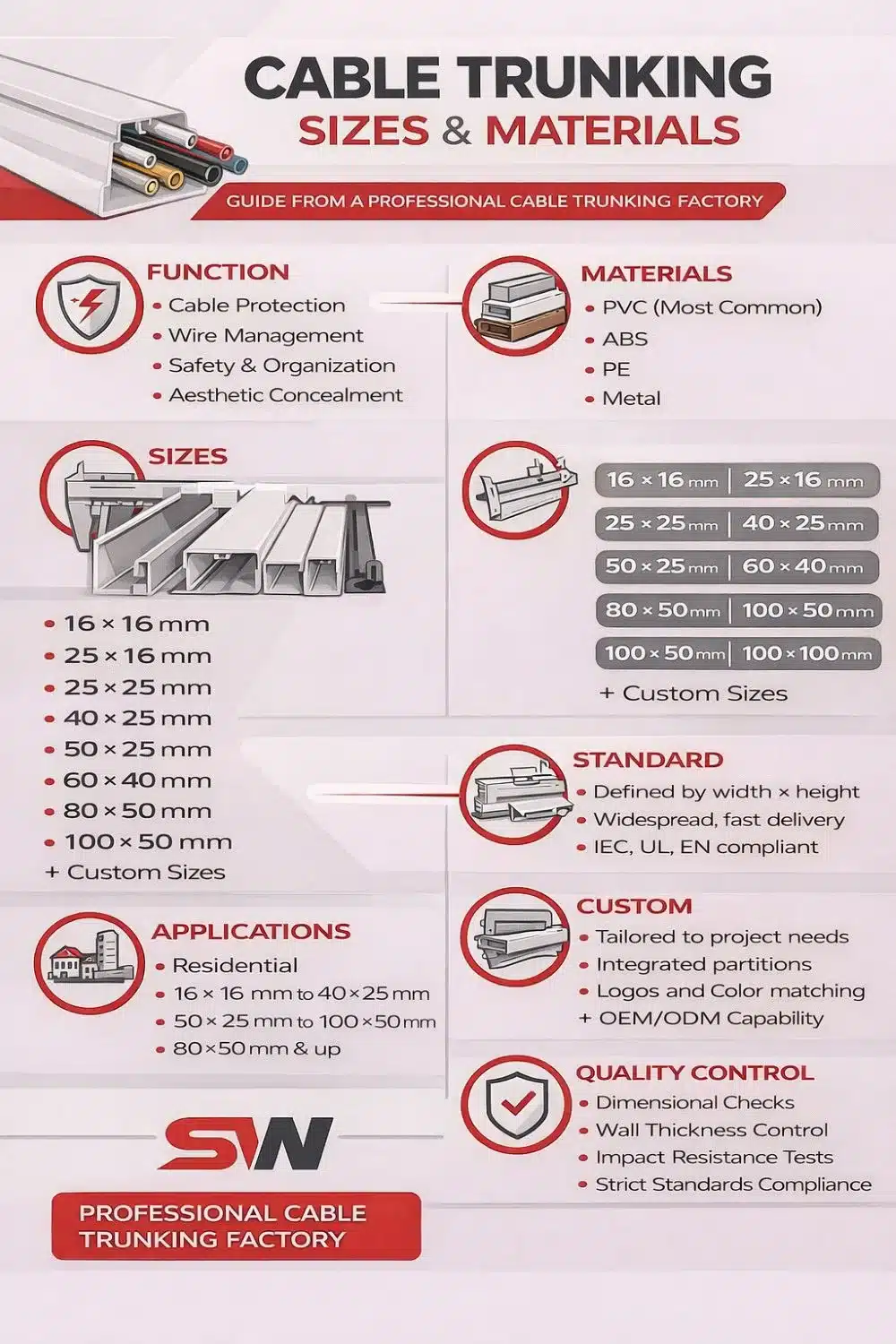
3. Common Materials Used in Cable Trunking Manufacturing
3.1 PVC Cable Trunking (Most Widely Used)
PVC (Polyvinyl Chloride) is the most common material used in plastic cable trunking.
Key properties:
Excellent electrical insulation
Moisture and corrosion resistance
Cost-effective extrusion processing
Smooth surface finish
Easy cutting and installation
At SW, PVC cable trunking extrusion allows precise control of cable trunking sizes, wall thickness, and internal partitions.
3.2 ABS Cable Trunking
ABS cable trunking is often selected for environments requiring higher impact resistance.
Advantages:
Strong mechanical strength
Good heat resistance
Durable in commercial environments
Limitations:
Higher material cost than PVC
Less flexible during extrusion
3.3 PE Cable Trunking
PE (Polyethylene) cable trunking is commonly used in underground or outdoor applications.
Advantages:
High chemical resistance
Excellent flexibility
Good impact resistance at low temperatures
PE cable trunking sizes are often customized for infrastructure projects.
3.4 Metal Cable Trunking (Steel / Aluminum)
Although not extruded plastic, metal cable trunking is used in heavy-duty industrial environments.
Advantages:
High fire resistance
Mechanical protection
Disadvantages:
Corrosion risk
Higher installation cost
Limited customization
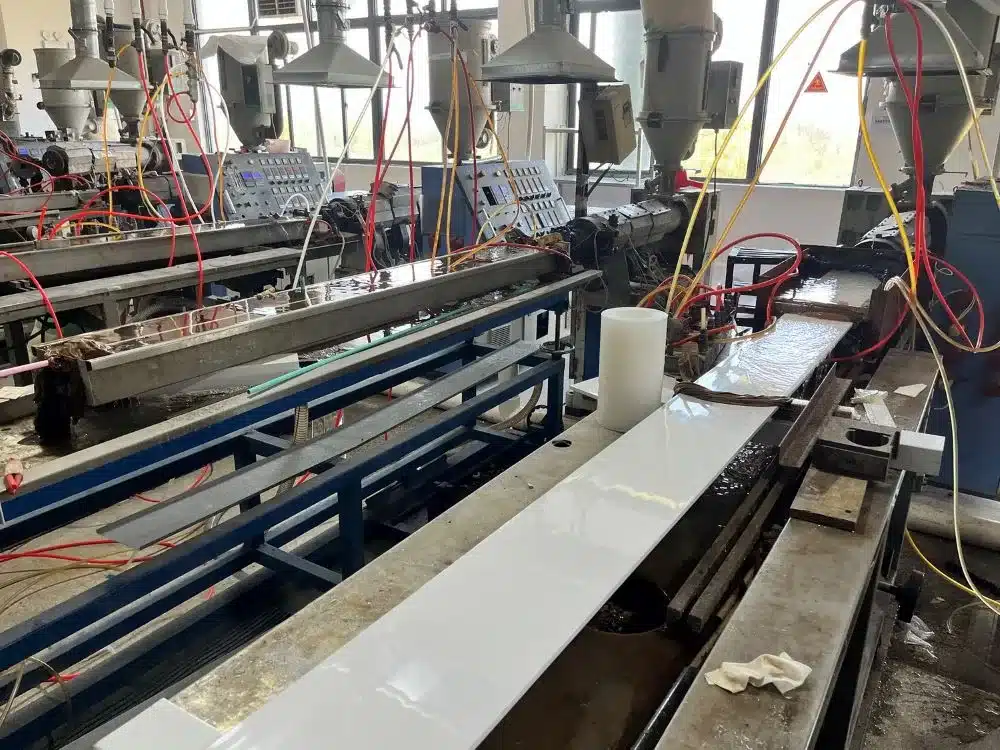
4. Plastic Extrusion Process for Cable Trunking Manufacturing
As a cable trunking factory, SW uses advanced plastic extrusion technology to produce consistent and accurate cable trunking sizes.
Typical extrusion workflow:
Raw material formulation
High-speed mixing and drying
Extruder feeding and melting
Precision die shaping
Vacuum calibration
Cooling and stabilization
Haul-off speed control
Cutting to standard or custom length
Dimensional inspection
Packaging and labeling
This process ensures stable cable trunking sizes across high-volume production.


5. Standard Cable Trunking Sizes and Dimensions
Cable trunking sizes are typically defined by width × height, expressed in millimeters.
Common standard cable trunking sizes include:
16 × 16 mm
25 × 16 mm
25 × 25 mm
40 × 25 mm
50 × 25 mm
60 × 40 mm
80 × 50 mm
100 × 50 mm
100 × 100 mm
At SW, we also specialize in custom cable trunking sizes for project-specific requirements.
6. Cable Trunking Sizes by Application Scenario
6.1 Residential Applications
Typical sizes: 16×16 mm to 40×25 mm
Used for lighting cables, power outlets, and data lines
6.2 Commercial Buildings
Typical sizes: 50×25 mm to 100×50 mm
Used for structured cabling, office power distribution
6.3 Industrial Facilities
Typical sizes: 80×50 mm and above
Used for control panels, automation systems
Choosing the correct cable trunking sizes ensures compliance and performance.
7. Cable Trunking Sizes and Cable Capacity Calculation
Profesional cable trunking manufacturers calculate cable capacity using:
Cable outer diameter
Total cable cross-sectional area
Recommended fill ratio (usually ≤ 45%)
Oversized cable trunking increases cost, while undersized cable trunking compromises safety.
8. Cable Trunking Materials and Fire Performance
Fire safety is a critical factor in cable trunking material selection.
PVC cable trunking: self-extinguishing grades available
ABS cable trunking: higher temperature tolerance
Metal cable trunking: non-combustible
SW provides flame-retardant formulations compliant with international standards.
9. Installation Considerations Based on Cable Trunking Sizes
Installation efficiency is strongly affected by cable trunking sizes.
Smaller sizes: faster installation, limited capacity
Larger sizes: heavier, require stronger fixing points
Proper planning ensures optimal cable trunking size selection.

10. Custom Cable Trunking Sizes from a Professional Manufacturer
As a custom cable trunking manufacturer, SW offers:
Non-standard dimensions
Integrated partitions
Snap-on or clip-on covers
Logo embossing
Color matching
Custom cable trunking sizes are widely used in branded projects and OEM applications.
11. Surface Finish and Aesthetic Considerations
Cable trunking is often visible after installation.
SW provides:
Matte finish
Gloss finish
Textured surface
Custom colors
These features enhance architectural integration while maintaining precise cable trunking sizes.
12. Quality Control of Cable Trunking Sizes
SW applies strict quality control measures:
Online dimensional monitoring
Wall thickness inspection
Cover fit testing
Impact and aging tests
This ensures consistency across all cable trunking sizes.
13. International Standards for Cable Trunking Sizes
Cable trunking systems often comply with:
IEC standards
EN standards
UL requirements
A professional cable trunking factory must align product sizes and materials with these standards.

14. Maintenance and Lifecycle Considerations
Correct cable trunking sizes reduce:
Cable stress
Heat buildup
Maintenance frequency
PVC cable trunking offers long service life with minimal maintenance.
15. Why Choose SW as Your Cable Trunking Factory
With 20 years of experience, SW provides:
In-house extrusion tooling design
Stable material formulation
Flexible cable trunking sizes
Servicios OEM y ODM
Global export capability
We are a solution-oriented cable trunking manufacturer, not just a supplier.
Selecting the Right Cable Trunking Sizes and Materials
Choosing the correct cable trunking sizes and materials is essential for safety, efficiency, and long-term system reliability. PVC cable trunking remains the most versatile and cost-effective solution, especially when manufactured by an experienced fábrica de extrusión de plástico.
With decades of technical expertise, SW continues to support global customers with reliable, customized cable trunking systems designed for modern infrastructure demands.
We have a cable trunking factory of skilled engineers ready to support you in your product development journey from idea design to production.Any ideas about your product you can contact us freely,and our engineers will get back to you with a quote asap. WhatsApp +86 188 2072 7151
¿Quién es Shuowei?
Desde 2006, Shuowei es una fábrica profesional de perfiles extruidos ubicada en Guangdong, China. Contamos con una plantilla de entre 51 y 100 personas. La fábrica de extrusión de PVC Shuowei se dedica al diseño y la producción de perfiles extruidos, como tuberías de PVC, canaletas de PE y zócalos de PVC. Desde sus inicios, nos hemos ganado el reconocimiento del mercado y la plena confianza de nuestros clientes gracias a nuestro ingenioso diseño, tecnología de vanguardia y la búsqueda constante de la calidad.
¿Es usted fabricante o comerciante?
Somos una empresa china de primera categoría. Perfiles de extrusión de PVC Somos fabricantes y nuestra fábrica está ubicada en Huizhou. Contamos con una planta de producción de 16 000 m², más de 5 líneas de producción automatizadas para perfiles de extrusión, una capacidad de producción anual de 30 000 toneladas y atendemos a más de 500 clientes en todo el mundo. ¡Le invitamos a visitar nuestra fábrica!
¿Cuál es su gama de productos?
Nos especializamos en el diseño y producción de alta calidad. perfiles de extrusión,tales como tuberías de PVC, extrusión de ABS, pantallas de lámparas de PC, zócalos de PVC, canaletas de PP, perfiles de PE…
¿Cuánto tiempo dura el proceso de desarrollo a medida?
Ofrecemos soporte para productos de extrusión personalizados. El proceso habitual consta de 4 pasos: confirmación de la demanda → diseño/prototipado 3D → certificación de pruebas → producción en masa (ciclo de 3 a 8 semanas).
¿Tienes alguna certificación internacional?
Hemos obtenido las certificaciones ISO 9001, CE, RoHS, SGS y otras, y cumplimos con los estándares principales de Europa, América, Oriente Medio y Asia.