



En la búsqueda implacable de la eficiencia industrial, los ingenieros y los responsables de adquisiciones a menudo se ven atrapados entre dos fuerzas opuestas: la necesidad de una alta resistencia química y los rigurosos límites presupuestarios de un proyecto. Tradicionalmente, si necesitabas un tubo para transportar ácidos altamente corrosivos o para resistir a la exposición extrema a los rayos UV, tenías que pagar un precio elevado. precio de los tubos de plástico para un fluoropolímero sólido de alta calidad o una resina especializada.
Pero ¿qué pasaría si no tuviéramos que elegir? ¿Qué pasaría si pudiéramos tener la “armadura” química de un material caro con la “economía” estructural de una resina estándar?
La respuesta está en Extrusión en coextrusion.
Como un fabricante de tuberías de plástico con más de 20 años de experiencia, SW ha sido pionera en el arte de la extrusión de múltiples capas. Desde nuestra Fábrica de tuberías de plástico de 6.000 metros cuadrados, En nuestro equipo de ingeniería hemos dominado la compleja ciencia de fusionar materiales diferentes para obtener un perfil de alto rendimiento. Esta guía explora cómo la coextrucción puede revolucionar su estrategia de adquisición, permitiéndole combinar resistencia química y bajo coste en un único producto unificado.
1. ¿Qué es la coextrusión en el mundo de los tubos de plástico?
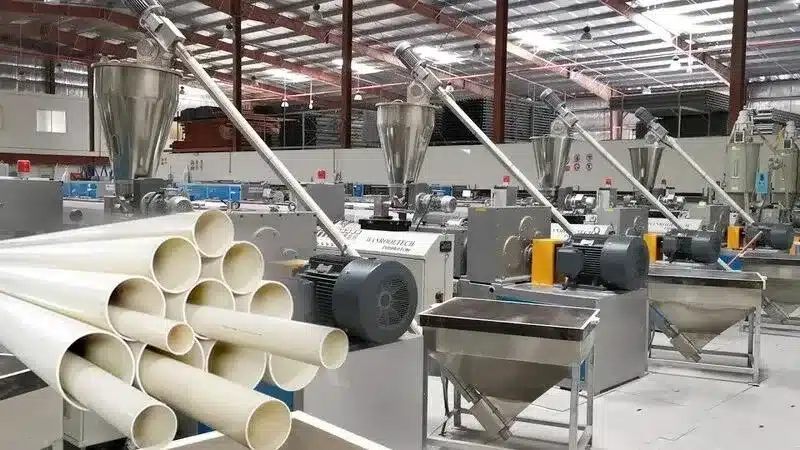
En esencia, la coextrusión es el proceso de presionar dos o más capas de plástico a través de la misma matriz de extrusión para producir una sola pieza. Conductos de plástico. A diferencia de la extrusión tradicional, en la que un tornillo funde un tipo de plástico, una línea de coextrusión en una fábrica profesional fábrica de tuberías de plástico Incluye múltiples extrusores que alimentan un “manifold de coextrusión” especializado o una “moldeadora de cabeza cruzada”.”
La Arquitectura Mecánica
Piensen en ello como un “sándwich” en forma de tubo. Tiene:
La capa interna (línea): Diseñado para el contacto directo con el medio (ácidos, aceites, lodos abrasivos).
La capa principal (estructural): Diseñado para proporcionar la resistencia mecánica y la rigidez del anillo.
La capa externa (la piel): Diseñado para la protección del medio ambiente (resistencia a los rayos UV, codificación de colores o resistencia a la abrasión).
Al controlar con precisión la espesura de cada capa, se puede fabricante de tuberías de plástico puede garantizar que la resina costosa y de alto rendimiento se utilice solo cuando sea absolutamente necesario, mientras que la mayor parte del tubo está fabricada con un material más económico y de alta resistencia.
2. El motor económico: cómo la coextrucción reduce el precio de los tubos de plástico
El principal motivo para la coextrusión en 2026 es la optimización de costos sin comprometer la calidad. Cuando se adquiera un material estándar con paredes sólidas Conductos de plástico, Al pagar por la resina de alta calidad, está pagando por toda la anchura de la pared.
La relación costo-eficacia
Imagina un proyecto que requiera PVDF (Fluoruro de vinilideno) por su excepcional resistencia química.
Conductos de PVDF sólidos: El precio de los tubos de plástico sería astronómico porque el 100% del material es resina de primera calidad.
Tubos coextruidos (línea de revestimiento de PVDF + núcleo estructural de PVC): Se logra la misma resistencia química en el interior, pero precio de los tubos de plástico entra de vez en cuando $60\% – 70\%$ porque la mayoría de la pared es de PVC económico.
Eficiencia en el material en la fábrica de tubos de plástico
En nuestro Instalación de 6.000 metros cuadrados, En nuestra empresa utilizamos sistemas de dosificación gravimétrica para garantizar que la capa “funcional” costosa sea lo más fina posible, a menudo hasta el punto de que no queda nada visible. $10\% – 15\%$ de la total anchura de la pared—al tiempo que se mantiene una barrera química perfecta. Este es el auténtico truco de adquisición para la infraestructura moderna.
3. La ciencia del enlace molecular: ¿Se pueden combinar todas las resinas?
Aquí es donde la experiencia de 20 años en SW cobra importancia crítica. No se puede simplemente mezclar dos plásticos y esperar que se adhieran. Si las resinas no son compatibles, las capas se “deslizan” (se desprenden), lo que lleva al fallo catastrófico del producto. Conductos de plástico.
Factores de compatibilidad
Un profesional fabricante de tuberías de plástico analiza tres variables clave antes de sugerir una fórmula de coextrusión:
Polaridad: Los plásticos polares (como el PVC o el ABS) generalmente no se adhieren bien a los plásticos no polares (como el PE o el PP) sin un “caparazón” especial o una resina adhesiva.
Índice de fluidez a la fusión (MFI): Las resinas deben tener características de fluidez similares en sus puntos de fusión. Si una es demasiado “acuosa” y la otra demasiado “viscosa”, no se fusionarán correctamente en la matriz.
Expansión térmica ($\alpha$): Si los dos plásticos se expanden y se contraen a tasas muy diferentes al calentarse, la tensión interna causará que Conductos de plástico deformarse o romperse con el tiempo.
(Dónde $ Delta L$ es el cambio de longitud, $L_0$ es el tamaño original, $\alpha$ es el coeficiente de dilatación térmica, y $ Delta T$ es el cambio de temperatura.)
Nuestros ingenieros utilizan este cálculo para garantizar que la coextrusión sea uniforme. Conductos de plástico permanecen estables durante toda su vida útil de 50 años.
4. Beneficios técnicos más allá del simple coste
Mientras que el precio de los tubos de plástico Es un factor importante: la coextrucción ofrece ventajas técnicas que un tubo de un solo material simplemente no puede igualar.
A. Codificación funcional de múltiples colores
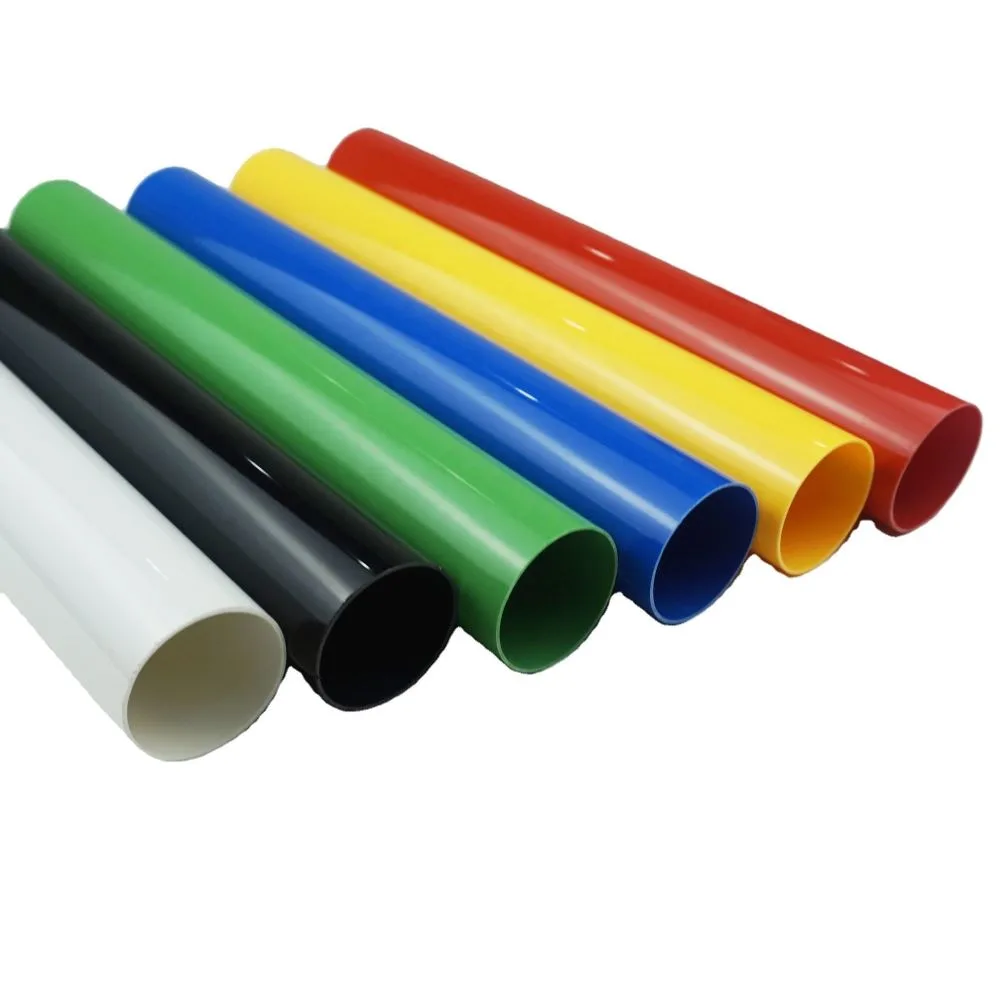
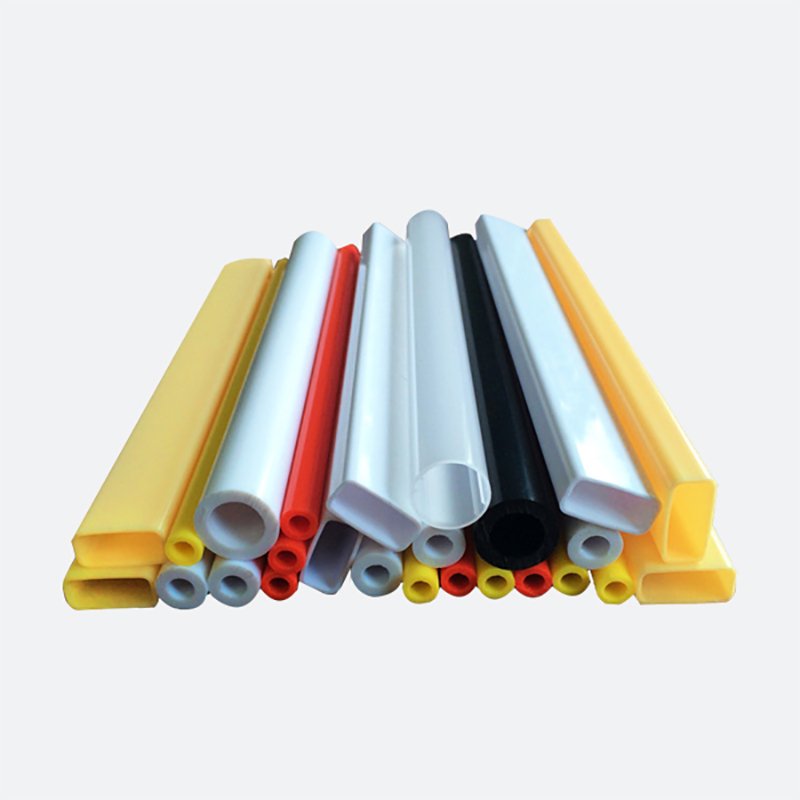
Nuestra especialización Extrusión multicapa de varios colores Nos permite producir tubos con diferentes colores tanto en el interior como en el exterior.
Ejemplo: Un interior blanco para una fácil inspección por video de los alcantarillados, con un exterior verde para la identificación de las instalaciones de servicios públicos.
Ejemplo: Un tubo de PE negro con rayas naranjas coextruidas para telecomunicaciones, lo que garantiza que el color nunca se descolora ni se agrieta porque forma parte de la pared del tubo.
B. Protección mejorada contra los rayos UV y la intemperie
Muchas resinas de alta resistencia, como el ABS, son susceptibles a la degradación por radiación UV. Al coextrudir una fina capa de ASA (Acrylonitrile Styrene Acrylate) sobre un núcleo de ABS, un fabricante de tuberías de plástico puede crear un tubo que tiene la resistencia a la presión de ABS pero la “infinita” resistencia al clima de ASA.
C. Utilización de contenido reciclado
En los proyectos que requieren estrictas normas ambientales en cuanto a la “huella de carbono”, la coextrusión es una solución eficaz. Podemos “envolver” resina reciclada de alta calidad entre dos capas de resina virgen. Esto permite que fábrica de tuberías de plástico Cumplir con los objetivos de sostenibilidad al tiempo que se garantiza que el producto solo contenga plástico puro y virgen.
5. Caso de estudio 1: La solución de ácido y residuos (envase C-PVC + núcleo de PVC)
Desafío del cliente: Una planta de procesamiento químico en el sudeste asiático necesitaba transportar $90^\circ\text{C}$ Aguas residuales ácidas. Sólido C-PVC (PVC clorado) Fue el único material que podía soportar la temperatura y la acidez, pero el total precio de los tubos de plástico excedió su presupuesto de gastos de capital $40\%$.
Solución SW: Nuestros ingenieros diseñaron un tubo coextruido a medida.
La capa interna: $1,5\text{mm}$ de PVC de alta calidad C para resistencia química y térmica.
Capa exterior: $5.5\text{mm}$ de PVC rígido estándar para soporte estructural y eficiencia en costos.
El resultado: * Ahorro de costos: El precio de los tubos de plástico fue reducido en $35\%$ en comparación con el PVC sólido C.
Desempeño: El tubo manejó el $90^\circ\text{C}$ Despacha perfectamente, ya que el revestimiento de PVC C protege el núcleo de PVC contra la degradación química.
Resultado: El cliente pudo completar el proyecto a tiempo y dentro del presupuesto, con una ventana de mantenimiento sin necesidad de reparaciones durante 25 años.
6. Caso de estudio 2: La "armadura estética" (ASA Skin + ABS Core)
Desafío del cliente: Un desarrollador de complejos turísticos de lujo requirió colores personalizados Conductos de plástico para un elemento de agua al aire libre expuesto. Los tubos necesitaban una alta resistencia a los impactos. ABS Para sobrevivir al tráfico público, necesitaban mantener una apariencia vibrante de “Ocean Blue” bajo el intenso sol tropical, sin que se “desvaneciera” ni se tornara amarilla.
Solución SW: Nos aprovechamos de nuestra Extrusión multicapa de varios colores Experiencia.
Core Interior: ABS virgen de alto impacto (color natural) para máxima resistencia.
Capa exterior: A $0,8\text{mm}$ capa de Ocean Blue ASA.
El resultado: * Consistencia visual: A diferencia de los tubos pintados, el color se coextruye en la piel, lo que significa que no se desprenderá.
Durabilidad: 5 años después, los tubos siguen tan vibrantes como el día en que nos dejaron. fábrica de tuberías de plástico, con una fragilidad cero relacionada con los rayos UV.
Coste: Al utilizar ABS natural como núcleo y tintar únicamente la piel de ASA, conseguimos mantener precio de los tubos de plástico competitivo con las tuberías estándar para exteriores.
7. Caso de estudio 3: El proyecto de infraestructura sostenible (HDPE de Virgin + HDPE reciclado)
Desafío del cliente: Un proyecto de “Ciudad Verde” municipal en Europa requirió 20.000 metros de desagüe de gran diámetro. Conductos de plástico. El mandato del proyecto exigía al menos $40\%$ Contiene contenido reciclado, pero los tubos debían pasar rigurosos controles de presión ISO y pruebas de “uniformidad interna” para garantizar la eficiencia de flujo.
Solución SW: Diseñamos una estructura coextruida “A-B-A”.
Cuerpos exteriores y interiores: HDPE virgen (PE100) para proporcionar una superficie de flujo suave y protección contra los productos químicos del suelo.
Core Medio: $50\%$ Regrind de HDPE reciclado de alta calidad y filtrado.
El resultado: * Cumplimiento: El proyecto pasó todas las auditorías ambientales relacionadas con el uso de contenido reciclado.
Desempeño: Debido a que el material reciclado estaba “encubierto” en el núcleo, el flujo interno del tubo y las características de soldadura por fusión externa eran idénticos a los de 100% tubos virgen. Conductos de plástico.
Impacto económico: El uso de material de núcleo reciclado redujo el consumo total precio de los tubos de plástico por $12\%$, que fue transferido directamente al municipio.
8. Garantía de calidad en la coextrusión: el estándar SW
En nuestro Fábrica de tuberías de plástico de 6.000 metros cuadrados, Sabemos que un tubo coextruido solo es tan bueno como su resistencia a la unión. Si las capas se separan, el tubo será inútil. Nuestro protocolo de calidad de 20 años incluye:
Test de inmersión en diclorometano: En los coextrusiones basadas en PVC, esta prueba revela si la fusión entre las capas es molecularmente sólida.
Test de resistencia a la pelado: Intentamos separar mecánicamente las capas para garantizar que el “enfoque interfacial” supere la resistencia a la tracción de las propias resinas.
Monitorización de la espesura de la pared mediante ultrasonidos: Nuestras líneas utilizan sensores ultrasónicos en tiempo real para garantizar que la “capa funcional” sea exactamente del mismo grosor que se ha prometido: ni más ni menos.
Auditoría de secciones transversales microscópicas: Cada lote se muestrea y examina bajo un microscopio de alta potencia para verificar la distribución de la capa “A-B”.

9. Cómo solicitar un presupuesto para los tubos de plástico coextruidos
Cuando usted contacta a fabricante de tuberías de plástico como SW para un proyecto de coextrusión: proporcionar los datos correctos le dará la información más precisa. precio de los tubos de plástico:
El “Medium”: ¿Qué líquido hay dentro? (nivel de pH, concentración, temperatura).
El “Medio Ambiente”: ¿El tubo está enterrado o expuesto a la luz del sol?
El “Pressión”: ¿Cuál es la presión de trabajo ($PN$ ¿calificación)?
El “Objetivo”: ¿Está tratando de ahorrar dinero, agregar color o agregar protección UV?
Con estas cuatro piezas de información, nuestros ingenieros pueden calcular las proporciones perfectas de capas para minimizar el consumo de energía. precio de los tubos de plástico al tiempo que maximiza el rendimiento.
¿Por qué la coextrucción es el futuro de los tubos personalizados?
La era del pensamiento “único” está llegando a su fin. A medida que los costos de los materiales aumentan y los requisitos de ingeniería se vuelven más especializados, la capacidad de Extrudir múltiples resinas en un solo tubo Es la herramienta más poderosa en tu arsenal de adquisiciones.
En SW, combinamos 20 años de sabiduría en la fabricación con la agilidad de una máquina moderna fábrica de tuberías de plástico. No solo suministramos productos; también diseñamos soluciones que equilibran la “resistencia química” que necesita su proyecto con el “bajo coste” que exige su presupuesto.
Si necesita un revestimiento C-PVC para productos ácidos calientes, una piel de ASA para protección contra los rayos UV o un núcleo reciclado para la sostenibilidad, contamos con la maquinaria y la experiencia necesarias para hacer que esto suceda.
¿Está usted preparado para optimizar los costos de su infraestructura? Contáctese hoy mismo con los expertos en ingeniería de SW. Cuéntenos sobre su proyecto más desafiante y démosle a nosotros la oportunidad de mostrarle cómo una solución personalizada de coextrusión puede reducir el precio de sus tuberías de plástico sin comprometer la calidad. Construyamos el futuro, una capa a la vez.
Contamos con una fábrica de tuberías de PVC y un equipo de ingenieros altamente cualificados, listos para apoyarle en el desarrollo de su producto, desde el diseño inicial hasta la producción. Si tiene alguna idea sobre su producto, no dude en contactarnos; nuestros ingenieros le enviarán un presupuesto lo antes posible. WhatsApp +86 188 2072 7151
¿Quién es Shuowei?
Desde 2006, Shuowei es una fábrica profesional de perfiles extruidos ubicada en Guangdong, China. Contamos con una plantilla de entre 51 y 100 personas. La fábrica de extrusión de PVC Shuowei se dedica al diseño y la producción de perfiles extruidos, como tuberías de PVC, canaletas de PE y zócalos de PVC. Desde sus inicios, nos hemos ganado el reconocimiento del mercado y la plena confianza de nuestros clientes gracias a nuestro ingenioso diseño, tecnología de vanguardia y la búsqueda constante de la calidad.
¿Es usted fabricante o comerciante?
Somos una empresa china de primera categoría. Perfiles de extrusión de PVC Somos fabricantes y nuestra fábrica está ubicada en Huizhou. Contamos con una planta de producción de 16 000 m², más de 5 líneas de producción automatizadas para perfiles de extrusión, una capacidad de producción anual de 30 000 toneladas y atendemos a más de 500 clientes en todo el mundo. ¡Le invitamos a visitar nuestra fábrica!
¿Cuál es su gama de productos?
Nos especializamos en el diseño y producción de alta calidad. perfiles de extrusión,tales como tuberías de PVC, extrusión de ABS, pantallas de lámparas de PC, zócalos de PVC, canaletas de PP, perfiles de PE…
¿Cuánto tiempo dura el proceso de desarrollo a medida?
Ofrecemos soporte para productos de extrusión personalizados. El proceso habitual consta de 4 pasos: confirmación de la demanda → diseño/prototipado 3D → certificación de pruebas → producción en masa (ciclo de 3 a 8 semanas).
¿Tienes alguna certificación internacional?
Hemos obtenido las certificaciones ISO 9001, CE, RoHS, SGS y otras, y cumplimos con los estándares principales de Europa, América, Oriente Medio y Asia.