



Why Choosing the Best Material for Skirting Board Matters?
In modern interior architecture and construction, the skirting board is no longer a purely decorative accessory. It plays a critical functional role in protecting walls, concealing gaps, managing cables, and enhancing the overall aesthetic of interior spaces. Selecting the best material for skirting board directly impacts durability, maintenance cost, installation efficiency, and long-term performance.
As a professional skirting board factory with more than 20 years of plastic extrusion experience, SW has designed and manufactured skirting board solutions for residential, commercial, hospitality, and industrial projects worldwide. This article provides a comprehensive, material-focused evaluation to help designers, contractors, and distributors identify the most suitable skirting board material for different applications.
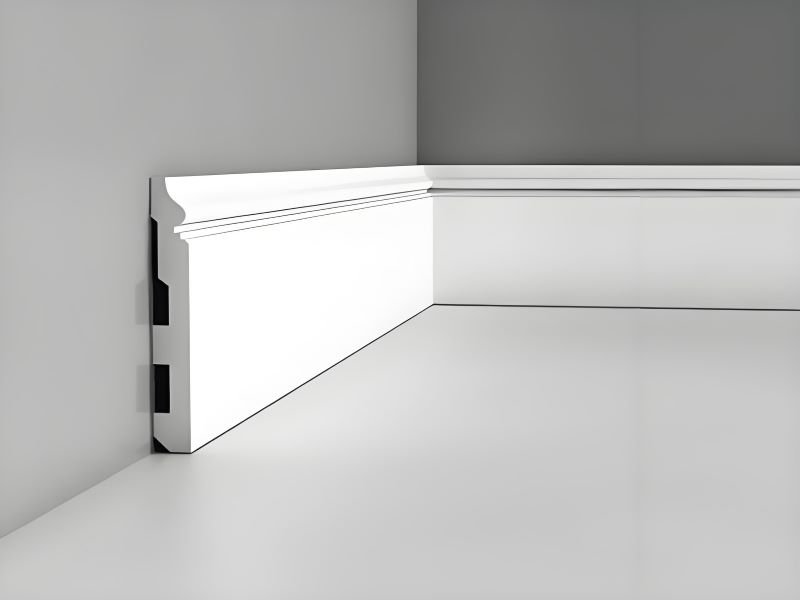
1. What Is a Skirting Board? Functional and Structural Overview
A skirting board (also called baseboard) is a finishing profile installed at the junction between wall and floor. From an engineering perspective, a skirting board serves several key functions:
Covers expansion gaps between flooring and wall
Protects wall surfaces from impact, moisture, and cleaning damage
Conceals wiring, conduits, and installation imperfections
Enhances visual continuity and architectural style
At SW, every skirting board extrusion is designed with functional geometry, optimized wall contact, and controlled dimensional tolerance to ensure stable installation.
2. Core Criteria for Selecting the Best Skirting Board Material
When evaluating the best material for skirting board, professional buyers typically consider the following technical factors:
Mechanical strength and impact resistance
Moisture and chemical resistance
Dimensional stability and tolerance control
Fire performance and safety compliance
Surface finish and aesthetic adaptability
Installation method and labor efficiency
Maintenance requirements and lifecycle cost
Sustainability and recyclability
Compatibility with extrusion manufacturing
Customization capability for profiles and colors
A qualified skirting board manufacturer must balance all these parameters.
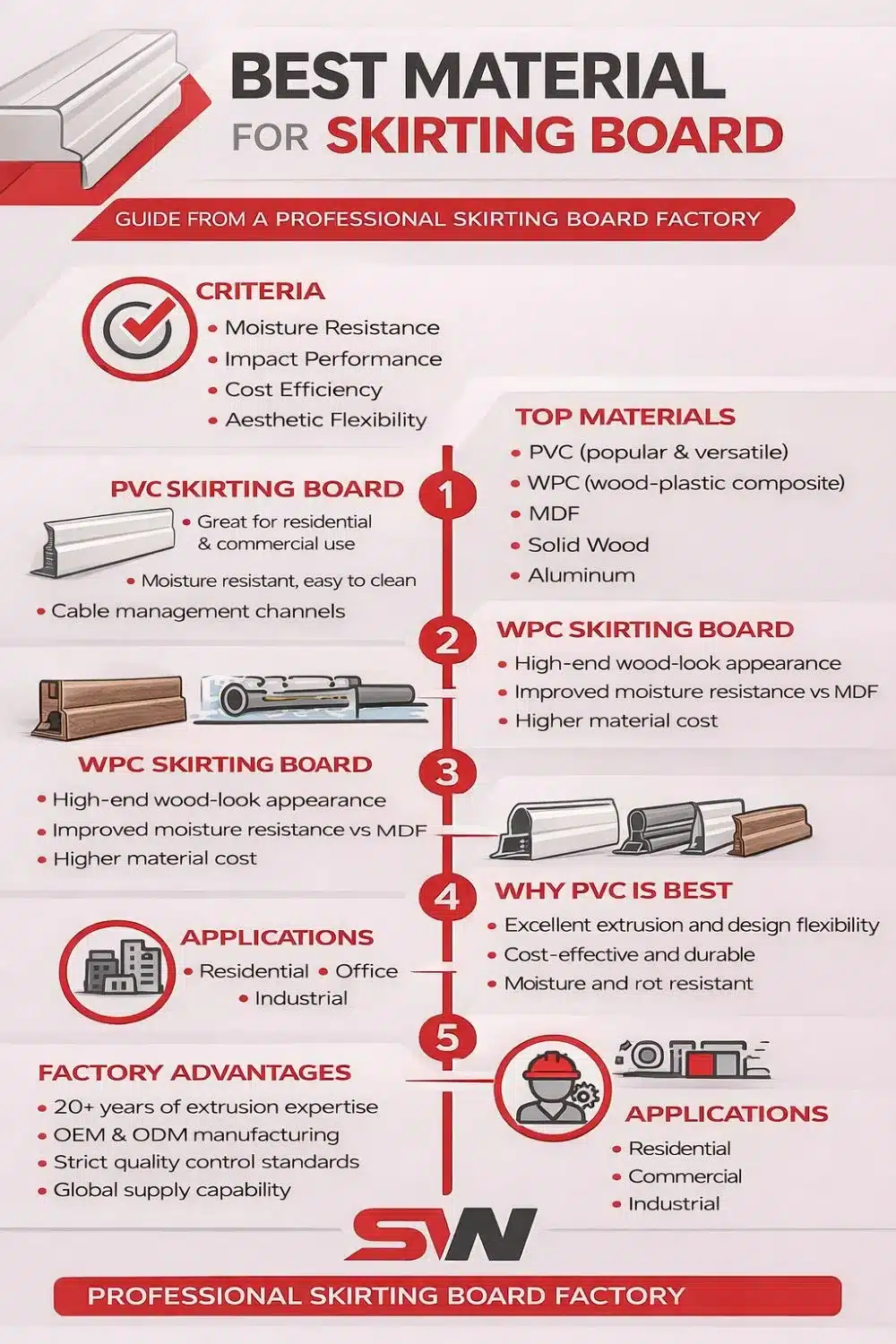
3. Overview of Common Skirting Board Materials
3.1 PVC Skirting Board (Most Popular Extruded Solution)
PVC (Polyvinyl Chloride) is currently the most widely used material for extruded skirting board systems.
Key properties of PVC skirting board:
Excellent moisture resistance
Stable extrusion behavior
Good impact resistance
Easy to clean and maintain
Competitive cost for mass production
At SW, PVC skirting board extrusion allows:
Multi-cavity internal design
Integrated cable management channels
High-precision surface embossing or matte finish
PVC is often regarded as the best material for skirting board in residential and commercial interiors.
3.2 WPC (Wood Plastic Composite) Skirting Board
WPC skirting board combines wood fiber with thermoplastics.
Advantages:
Natural wood-like appearance
Improved moisture resistance compared to MDF
Higher stiffness than standard PVC
Limitations:
Higher extrusion complexity
Greater thermal expansion
Higher material cost
WPC skirting board is typically used in high-end residential or boutique commercial projects.
3.3 MDF Skirting Board
MDF (Medium Density Fiberboard) skirting boards are traditionally popular in painted interiors.
Advantages:
Smooth paintable surface
Sharp edge definition
Disadvantages:
Poor moisture resistance
Not suitable for humid environments
Shorter service life compared to extruded skirting board materials
From a manufacturing standpoint, MDF is not extruded, limiting design flexibility.
3.4 Solid Wood Skirting Board
Solid wood skirting boards offer classic aesthetics.
Advantages:
Premium appearance
Natural texture
Disadvantages:
Susceptible to warping and moisture
High material and installation cost
Limited profile consistency
Solid wood is rarely used in large-scale modern projects due to cost and instability.
3.5 Aluminum Skirting Board
Aluminum skirting boards are used in minimalist or industrial designs.
Advantages:
Excellent durability
Fire resistance
Slim profile design
Disadvantages:
Cold visual effect
High cost
Limited acoustic and impact buffering
4. Why PVC Is Considered the Best Material for Skirting Board
From an extrusion engineering perspective, PVC offers the most balanced performance.
Technical reasons PVC excels:
Consistent melt flow for precision extrusion
Excellent compatibility with additives (impact modifiers, UV stabilizers)
Ability to co-extrude soft and rigid sections
Wide color and surface finish options
Cost efficiency for large-volume skirting board factory production
For these reasons, PVC skirting board remains the dominant solution in global markets.


5. Skirting Board Extrusion Process: Inside an SW Skirting Board Factory
At SW, the skirting board extrusion process follows a controlled industrial workflow:
Raw material formulation (PVC resin + additives)
High-speed mixing and pre-heating
Twin-screw extrusion for profile stability
Precision extrusion die shaping
Vacuum calibration and cooling
Haul-off speed control
Inline cutting to length
Surface finishing or embossing
Quality inspection and dimensional control
Packaging and labeling
This extrusion process enables custom skirting board manufacturing with tight tolerances.
6. Common Extruded Skirting Board Designs and Uses
Typical skirting board extrusion designs include:
Hollow cable-management skirting board
Solid flat skirting board
Flexible edge skirting board
High-profile decorative skirting board
Slim minimalist skirting board
Each design serves different architectural and functional needs.
7. Applications of Skirting Board by Environment
Residential
Living rooms
Bedrooms
Kitchens and bathrooms (PVC preferred)
Commercial
Offices
Retail spaces
Hotels
Industrial
Clean rooms
Laboratories
Utility corridors
PVC skirting board is particularly suitable for high-humidity and high-traffic environments.
8. Installation Compatibility by Material
PVC skirting board supports:
Adhesive installation
Clip-on systems
Mechanical fixing
Compared to MDF or wood, extruded PVC skirting board offers faster installation and lower failure risk.

9. Durability, Maintenance, and Lifecycle Cost
From a lifecycle cost perspective:
PVC skirting board: low maintenance, long lifespan
MDF skirting board: frequent replacement in humid zones
Wood skirting board: high maintenance cost
Aluminum skirting board: high initial cost
PVC offers the best cost-performance ratio.
10. Sustainability and Environmental Considerations
Modern PVC skirting board production at SW includes:
Lead-free formulations
Recyclable material streams
Optimized extrusion energy efficiency
As a responsible skirting board manufacturer, SW aligns with global environmental standards.
11. How to Choose the Best Skirting Board Material for Your Project
Choose PVC skirting board if you need:
Moisture resistance
Cable management
Cost efficiency
Design flexibility
Choose WPC or wood skirting board if:
A natural appearance is the top priority
Budget allows premium materials

12. Why Choose SW as Your Skirting Board Factory
SW offers:
20 years of skirting board extrusion expertise
In-house die design and material formulation
OEM and ODM skirting board manufacturing
Stable global supply capability
Strict quality control standards
We are not only a skirting board factory, but also a solution-oriented skirting board manufacturer.
What Is the Best Material for Skirting Board?
From a technical, economic, and application-driven perspective, PVC remains the best material for skirting board in most modern projects. Its extrusion compatibility, durability, customization flexibility, and cost efficiency make it the preferred choice for architects, developers, and contractors worldwide.
With decades of experience, SW continues to innovate in skirting board extrusion, delivering high-performance solutions tailored to global market demands.
We have a PVC pipes factory of skilled engineers ready to support you in your product development journey from idea design to production.Any ideas about your product you can contact us freely,and our engineers will get back to you with a quote asap. Whatsapp +86 188 2072 7151
Who is Shuowei?
Since 2006, Shuowei is a professional extrusion profiles factory based in Guangdong, China. There are total about 51-100 people in our office. Shuowei PVC extrusion factory is committed to the design and production of extruded profiles, such as PVC pipes, PE trunking, PVC skirting line. Since its inception, we have won the wide recognition of the market and the deep trust of customers with our ingenious design, exquisite technology and the ultimate pursuit of quality.
Are you a manufacturer or a trader?
We are a Chinese top PVC extrusion profiles manufacturer and our factory is located in Huizhou. Our factory has a 16,000㎡ production base, 5+ automated extrusion profiles production lines, an annual production capacity of 30,000 tons, and serves more than 500 customers worldwide. Welcome to visit our factory!
What is your product range?
We pecialize in the design and production of high quality extrusion profiles,such as PVC pipe, ABS extrusion, PC lampshades, PVC skirting lines, PP trunking, PE profiles…
How long does the custom development process take?
We support custom extrusion products. The usual process has 4 steps: demand confirmation → 3D design/proofing → test certification → mass production (cycle 3-8 weeks).
Do you have any international certifications?
We have passed ISO 9001, CE, RoHS, SGS and other certifications, and meet the mainstream standards of Europe, America, the Middle East and Asia


