





As data centers continue to expand worldwide, the requirements for cable trunking systems are becoming more demanding than ever. Traditional PVC cable trunking remains a popular choice because of its cost-effectiveness, flame resistance, and ease of installation. However, some engineers and procurement teams are now exploring advanced material blends such as PVC+ABS, hoping to achieve better impact resistance, improved dimensional stability, enhanced appearance, and higher performance in critical infrastructure environments.
This raises an important question:
Can a standard PVC extrusion line successfully process high-performance blends like PVC+ABS for cable trunking, or does mixing materials create unacceptable risks such as warping, twisting, shrinkage variation, and dimensional instability?
The answer is more complex than a simple yes or no.
As a professional PVC cable trunking manufacturer with more than 20 years of extrusion experience, SW has developed custom formulations for customers across more than 50 countries. We have seen both successful and failed attempts at producing hybrid-material cable trunking systems.
This article provides a practical engineering perspective on:
- Why customers consider PVC+ABS blends
- The compatibility challenges between PVC and ABS
- Why dimensional warping occurs
- Whether standard PVC extrusion equipment is sufficient
- How professional PVC cable trunking factories control shrinkage
- Proven methods to prevent twisted and warped cable trunking profiles
- When blended materials make sense—and when they do not

Why Data Center Cable Trunking Requires Higher Performance Materials
Modern data centers are very different from conventional commercial buildings.
A typical data center contains:
- High cable density
- Large power distribution systems
- Constant airflow
- Elevated operating temperatures
- Strict fire safety requirements
- Frequent maintenance access
As a result, many buyers seek cable trunking materials that provide:
- Better impact resistance
- Improved dimensional accuracy
- Enhanced flame retardancy
- Long-term stability
- Better appearance
This is why some procurement teams investigate PVC+ABS hybrid materials.
What Is a PVC+ABS Blend?
A PVC+ABS blend combines two very different polymers.
PVC Contribution
PVC provides:
- Flame retardancy
- Chemical resistance
- Cost efficiency
- Electrical insulation
- Good rigidity
ABS Contribution
ABS provides:
- Higher impact resistance
- Better toughness
- Improved surface finish
- Better low-temperature performance
In theory, combining the two materials seems ideal for premium cable trunking applications.
In practice, however, things become more complicated.


The Biggest Challenge: PVC and ABS Are Not Naturally Compatible
One of the most common misconceptions is that polymers behave like metals.
They do not.
Simply mixing two plastics together does not guarantee a stable material.
PVC and ABS have:
- Different molecular structures
- Different processing windows
- Different rheological behavior
- Different shrinkage characteristics
Without proper formulation engineering, blending these materials can create significant problems.
Why Dimensional Warping Happens in Hybrid Cable Trunking
Warping is the most common complaint when poorly designed material blends are used.
Typical defects include:
- Twisted trunking lengths
- Bowing
- Lid mismatch
- Snap-fit misalignment
- Uneven wall dimensions
- Corner distortion
These defects often appear after cooling rather than immediately after extrusion.
Understanding Differential Shrinkage
The primary cause of warping is differential shrinkage.
Every polymer shrinks differently as it cools.
Typical PVC Behavior
Rigid PVC generally exhibits relatively low shrinkage.
Typical ABS Behavior
ABS generally exhibits higher and more complex shrinkage patterns.
When combined improperly:
- One portion of the profile contracts faster
- Internal stress develops
- The profile bends or twists
This becomes especially problematic in long cable trunking sections.
Why Cable Trunking Profiles Are More Sensitive Than Pipes
Many engineers assume that if blended materials work in pipes, they should also work in cable trunking.
This assumption is dangerous.
Pipes Have Symmetrical Geometry
Pipes cool relatively evenly.
Their circular shape distributes stress uniformly.
Cable Trunking Has Complex Geometry
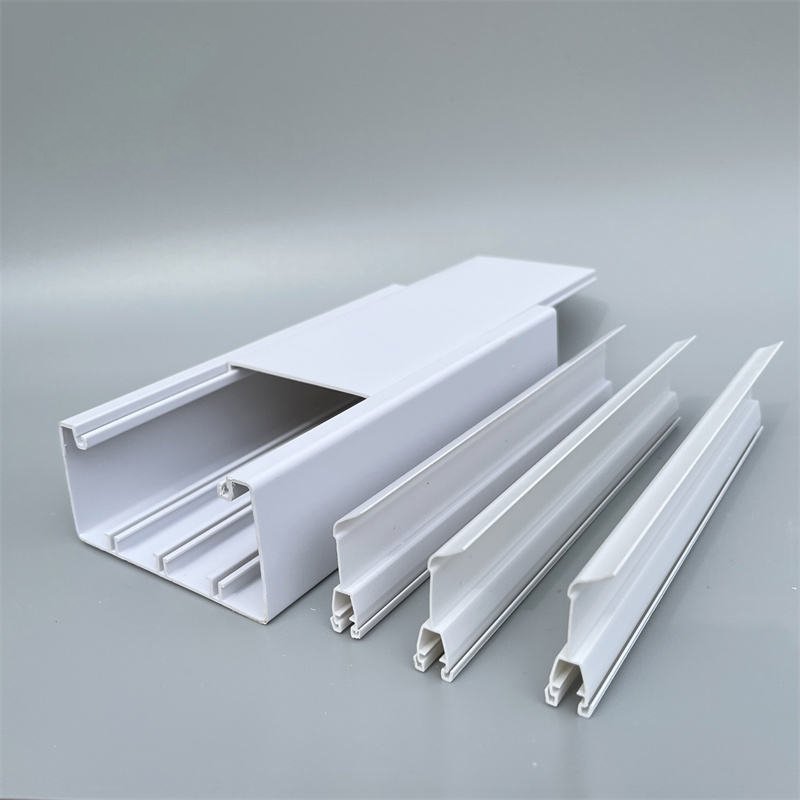
A typical PVC cable trunking profile includes:
- Side walls
- Base section
- Lid locking features
- Internal ribs
- Corner radii
These features cool at different rates.
The more complex the profile, the higher the warping risk.
Can a Standard PVC Extruder Process PVC+ABS Blends?
The technical answer is:
Sometimes yes.
Sometimes no.
The outcome depends on multiple factors.
Factor 1: Screw Design
A standard PVC screw is optimized for rigid PVC.
PVC+ABS blends may require:
- Different compression ratios
- Improved mixing sections
- Controlled shear levels
If the screw design is unsuitable:
- Poor dispersion occurs
- Material separation increases
- Dimensional consistency decreases
Factor 2: Processing Temperature Window
PVC and ABS prefer different processing temperatures.
PVC typically processes at lower temperatures.
ABS generally requires higher temperatures.
This creates a narrow operating window.
If temperatures are too low:
- Poor fusion occurs
If temperatures are too high:
- PVC degradation begins
A professional PVC cable trunking manufacturer must carefully optimize this balance.
Factor 3: Calibration System Design
For custom cable trunking, calibration is critical.
Improper vacuum calibration can create:
- Asymmetrical cooling
- Residual stress
- Shape distortion
Hybrid materials often require redesigned calibration tooling.

Why Material Compatibility Agents Matter
One major reason PVC+ABS projects fail is the absence of compatibilizers.
Compatibilizers help:
- Improve interfacial bonding
- Reduce phase separation
- Improve mechanical performance
- Enhance dimensional stability
Without them, the blend may behave like two separate materials trapped together.
Signs of Poor PVC+ABS Compatibility
A buyer may observe:
- Surface streaking
- Gloss inconsistency
- Internal delamination
- Corner cracking
- Lid fit issues
- Dimensional instability
These symptoms often indicate inadequate material engineering.
How Professional Cable Trunking Manufacturers Prevent Warping
At SW, we approach blended-material cable trunking projects through a structured engineering process.
Step 1: Analyze Functional Requirements
Before selecting materials, we determine:
- Fire requirements
- Impact requirements
- Installation environment
- Operating temperature
- Cable load
In many cases, pure PVC may already meet requirements.
Step 2: Evaluate Whether a Blend Is Actually Necessary
Many customers assume hybrid materials automatically perform better.
This is not always true.
For example:
Modified PVC compounds often achieve:
- Excellent impact resistance
- Better flame performance
- Lower cost
- Easier processing
without introducing compatibility risks.
Step 3: Conduct Material Compatibility Trials
For projects requiring PVC+ABS blends, we perform:
- Rheological testing
- Fusion analysis
- Compatibility evaluation
- Shrinkage studies
before production begins.
Step 4: Optimize Cooling Balance
Cooling design is often more important than extrusion speed.
We evaluate:
- Water temperature
- Vacuum calibration layout
- Cooling length
- Airflow distribution
to ensure uniform contraction.
Step 5: Measure Warpage Quantitatively
Professional PVC cable trunking manufacturers should never rely solely on visual inspection.
We measure:
- Straightness deviation
- Twist angle
- Width tolerance
- Lid engagement accuracy
using precision inspection systems.
Alternative Solution: Impact-Modified PVC
In many data center applications, impact-modified PVC offers a better solution than PVC+ABS.
Advantages include:
- Lower processing risk
- Better flame resistance
- More predictable shrinkage
- Better dimensional consistency
- Lower production cost
This is why many premium PVC cable trunking systems use advanced modified PVC rather than hybrid polymer blends.
The Hidden Cost of Material Blends
Many buyers focus only on material performance.
However, hybrid formulations introduce additional costs:
Tooling Development
New blends often require:
- Tool modifications
- Calibration redesign
- Process optimization
Higher Scrap Rates
Warping increases rejection rates.
Longer Development Cycles
Material qualification takes more time.
Inventory Complexity
Additional raw material management becomes necessary.
How to Specify a PVC+ABS Cable Trunking Project Correctly
If you decide to pursue a blended material solution, specify the following:
Dimensional Tolerance Requirements
Example:
- Width tolerance ±0.2 mm
- Height tolerance ±0.2 mm
Straightness Requirements
Example:
- Maximum bowing per meter
Lid Retention Requirements
Specify:
- Opening force
- Retention force
Environmental Conditions
Define:
- Installation temperature
- Operating temperature
- Indoor or outdoor use
Common Mistakes Buyers Should Avoid
Mistake 1: Assuming All Material Blends Behave Similarly
Every blend behaves differently.
Mistake 2: Evaluating Only Short Samples
A 100 mm sample may appear perfect.
A 2-meter trunking section may reveal severe warping.
Mistake 3: Ignoring Cooling Design
Most warping problems originate during cooling.
Mistake 4: Choosing Material Based Only on Marketing Claims
Always request testing data.
Real-World Recommendation From SW
Based on more than 20 years of extrusion experience, our recommendation is straightforward:
For most data center cable trunking projects:
- Start with optimized PVC formulations.
- Evaluate impact-modified PVC first.
- Consider PVC+ABS blends only when performance requirements exceed modified PVC capabilities.
This approach usually delivers:
- Better dimensional stability
- Lower production risk
- Faster development
- Better cost-performance balance
Future Trends in High-Performance Cable Trunking Materials
The industry is increasingly adopting:
- Advanced impact-modified PVC
- PVC-acrylic systems
- Nano-reinforced PVC compounds
- Low-shrinkage engineering formulations
- Simulation-based extrusion optimization
These technologies often outperform traditional PVC+ABS blends while maintaining easier process control.
Why SW Is a Trusted PVC Cable Trunking Manufacturer
With more than 20 years of extrusion expertise, SW helps customers develop custom cable trunking solutions that balance:
- Mechanical performance
- Flame resistance
- Dimensional stability
- Cost efficiency
- Manufacturing reliability
Our engineering team evaluates material compatibility, shrinkage behavior, tooling design, and cooling systems before recommending any hybrid formulation.

Can a Standard PVC Extruder Handle PVC+ABS Cable Trunking?
The answer depends on the formulation, tooling, process control, and performance requirements.
A standard PVC extruder can sometimes process PVC+ABS blends successfully, but without proper engineering, the risk of dimensional warping, twisting, lid mismatch, and long-term instability increases significantly.
For most applications, a carefully engineered modified PVC compound provides a safer and more cost-effective solution. When hybrid materials are necessary, success depends on:
- Proper compatibilizers
- Controlled shrinkage
- Precision calibration
- Optimized cooling
- Rigorous dimensional verification
The key is not simply mixing materials. The key is understanding how those materials behave throughout the entire extrusion process.
For buyers seeking reliable custom PVC cable trunking, partnering with an experienced PVC cable trunking manufacturer like SW is the most effective way to achieve high-performance materials without sacrificing dimensional accuracy.
We have a PVC pipes factory of skilled engineers ready to support you in your product development journey from idea design to production.Any ideas about your product you can contact us freely,and our engineers will get back to you with a quote asap. Whatsapp +86 188 2072 7151
Who is Shuowei?
Since 2006, Shuowei is a professional extrusion profiles factory based in Guangdong, China. There are total about 51-100 people in our office. Shuowei PVC extrusion factory is committed to the design and production of extruded profiles, such as PVC pipes, PE trunking, PVC skirting line. Since its inception, we have won the wide recognition of the market and the deep trust of customers with our ingenious design, exquisite technology and the ultimate pursuit of quality.
Are you a manufacturer or a trader?
We are a Chinese top PVC extrusion profiles manufacturer and our factory is located in Huizhou. Our factory has a 16,000㎡ production base, 5+ automated extrusion profiles production lines, an annual production capacity of 30,000 tons, and serves more than 500 customers worldwide. Welcome to visit our factory!
What is your product range?
We pecialize in the design and production of high quality extrusion profiles,such as PVC pipe, ABS extrusion, PC lampshades, PVC skirting lines, PP trunking, PE profiles…
How long does the custom development process take?
We support custom extrusion products. The usual process has 4 steps: demand confirmation → 3D design/proofing → test certification → mass production (cycle 3-8 weeks).
Do you have any international certifications?
We have passed ISO 9001, CE, RoHS, SGS and other certifications, and meet the mainstream standards of Europe, America, the Middle East and Asia


