





Authored for global OEMs, product designers, and industrial procurement teams — by SW, a specialized ABS extrusion factory with 20+ years of engineering expertise
1. Why ABS Extrusion Matters in Modern Manufacturing
Acrylonitrile-Butadiene-Styrene (ABS) is one of the world’s most important engineering thermoplastics. Its unique combination of toughness, rigidity, chemical resistance, electrical insulation, and excellent surface finish makes it the preferred material for a wide range of industrial and consumer products. When ABS is processed through extrusion — a continuous manufacturing technique that shapes molten polymer through a die — the result is a high-performance linear profile known as ABS extrusion.
From structural profiles to protective covers, trim components, conduit pipes, and appliance parts, ABS extrusion enables scalable, cost-efficient production with high dimensional stability. As industries shift toward lightweighting, modular assembly, precision design and engineered plastics, the global demand for ABS extrusion factory capabilities continues to rise.
For more than 20 years, SW has specialized in ABS extrusion, delivering custom profiles for automotive, industrial, medical, construction, appliance, and consumer product applications. Our engineering knowledge, die-design expertise, and ISO-based process control allow us to support OEMs worldwide.
This blog explains ABS extrusion in depth — including material science, extrusion processes, product applications, how an ABS extrusion manufacturer operates, and critical usage guidelines.

2. What Is ABS? Material Composition & Structure
ABS is a terpolymer made from:
Acrylonitrile (A) – provides chemical resistance & heat stability
Butadiene (B) – provides impact strength & toughness
Styrene (S) – provides rigidity and surface gloss
ABS is considered a high-impact engineered thermoplastic offering excellent mechanical balance. In ABS extrusion, material behavior is particularly important:
Key Material Characteristics:
| Property | Description |
|---|---|
| Glass Transition Temperature (Tg) | ~105°C, providing thermal stability |
| Density | 1.03–1.07 g/cm³ |
| Tensile Strength | 40–50 MPa |
| Impact Strength | High, due to butadiene rubber particles |
| Chemical Resistance | Good resistance to acids & alkalis |
| Surface Quality | High gloss or matte achievable |
ABS resins for extrusion may be modified with:
UV stabilizers (for outdoor use)
Fire-retardant additives (home appliances, electronics)
Color masterbatches (exact Pantone color control)
Reinforcements (glass fibers for stiff profiles)
This versatility makes ABS extrusion suitable for thousands of engineered components.


3. Physical & Mechanical Properties Relevant to ABS Extrusion
ABS behaves predictably under extrusion due to:
1. Excellent Melt Strength
Allows the molten plastic to maintain shape after exiting the die.
2. Low Shrinkage (0.3–0.7%)
Ensures dimensional accuracy and consistent tolerances.
3. High Impact Resistance
Crucial for structural trim, automotive components, and protective housings.
4. Good Die-Flow Behavior
Supports complex profiles and multi-chamber cross-sections.
5. Excellent Surface Finish
Smooth, glossy, or textured surfaces can be achieved without post-processing.
These material properties allow ABS extrusion factories like SW to deliver parts requiring tight precision and aesthetic quality.
4. Advantages of ABS Extrusion
ABS extrusion offers significant engineering and manufacturing benefits:
1. Strength–to–Weight Efficiency
Strong but lightweight profiles replace metals in structural and functional components.
2. Superior Impact Resistance
Ideal for covers, guards, bumpers, edging, and consumer electronics housings.
3. Color & Surface Customizability
Products can be extruded in full-color, eliminating post-painting.
4. High Dimensional Stability
Supports parts that must maintain tolerance under load or temperature fluctuations.
5. Cost-Effective for High Volumes
Continuous extrusion reduces per-unit cost dramatically.
6. Chemical & Electrical Performance
Widely used for protective conduit, wire channels, HVAC covers, office systems.
7. Recyclability
ABS scrap can be reprocessed, supporting sustainability goals.
These strengths explain why ABS extrusion manufacturers serve industries from automotive to medical equipment.
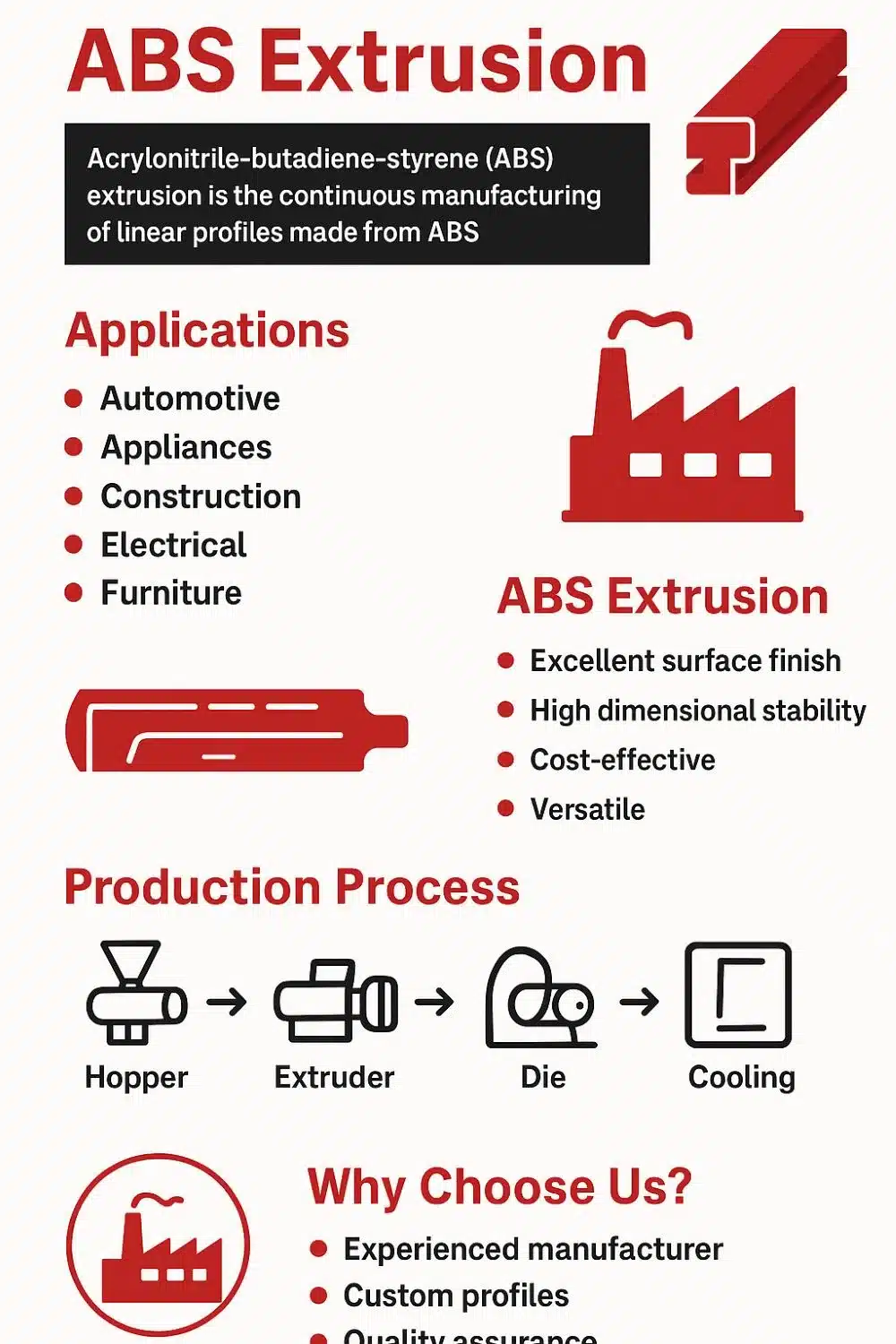
5. Applications of ABS Extrusion Across Industries
ABS extrusion is used in hundreds of engineering environments. Below are major industry segments and common profiles:
1. Automotive Industry
Interior trim
Pillar covers and dashboard components
Cable channels
Protective guards
Decorative strips
2. Consumer Appliances
Refrigerator liners
Air-conditioner ducting
Vacuum cleaner housings
Washing machine frames
3. Construction & Architecture
Door & window trim
Wall corner guards
Cable trunking
Handrail covers
4. Electrical & Electronics
Wire conduit
PCB protective channels
Battery casing profiles
5. Industrial Machinery
Protective covers
Machine guards
Tool guides
6. Furniture Manufacturing
Edge trim
Structural channel profiles
Decorative finishing profiles
7. Medical Equipment
Lightweight housings
Protective rails
Device channels
Industries with medium-to-high product complexity increasingly prefer ABS extrusion due to precision, clean aesthetics, and durability.
6. How to Choose the Right ABS Pipe or Profile
Choosing the correct ABS extrusion profile depends on several engineering factors:
1. Mechanical Requirements
Load-bearing or structural?
Impact environment?
Flexibility vs rigidity?
2. Chemical Environment
Exposure to oils, detergents, weak acids?
3. Temperature Conditions
Indoor vs outdoor
Continuous service temperature
4. Color & Surface Finish
UV stability needed?
Glossy, matte, textured?
5. Dimensional Tolerance
±0.2 mm?
±0.5 mm?
Multi-chamber precision requirements?
6. Certification Requirements
UL fire rating
RoHS, REACH compliance
FDA contact safety
7. Cost Targets
Standard ABS
High-impact ABS
FR-ABS
Recycled ABS for low-cost projects
Our team at SW helps customers choose the optimal ABS material and extrusion design based on application and engineering requirements.
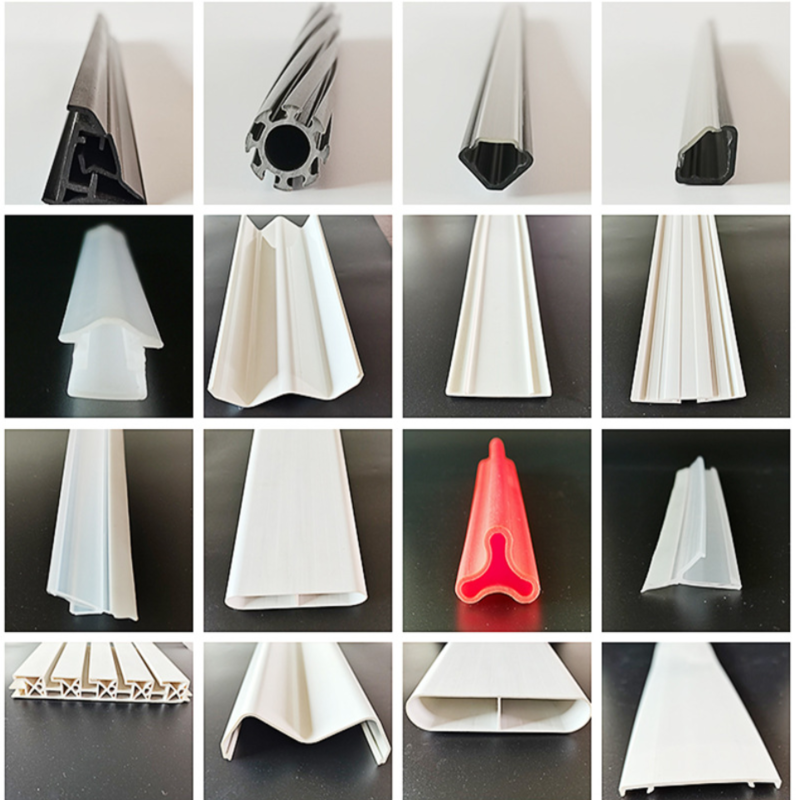
7. How an ABS Extrusion Factory Produces ABS Profiles
As a professional ABS extrusion factory with 20+ years of experience, SW follows a highly controlled, ISO-certified process.
Step 1: Material Selection & Pre-Drying
ABS resin pellets
Additives (UV, FR, color pigment)
Moisture is removed at 80–90°C to prevent bubbles
Step 2: Extruder Feeding & Melting
Single or twin-screw extruders
Temperature zones: 170–220°C
Controlled screw speed ensures stable melt flow
Step 3: Extrusion Die Calibration
Custom precision steel dies
Multi-cavity/high-complexity structures
Designed in SW’s internal mold workshop
Step 4: Forming & Calibration
Sizing plates and vacuum calibration tanks ensure accurate dimensions
Step 5: Cooling Process
Water baths stabilize shape
Air knives remove moisture from the surface
Step 6: Pulling & Cutting
Servo pullers ensure uniform linear speed
Automated cutters trim exact lengths (±1 mm tolerance)
Step 7: Surface Treatment (Optional)
Co-extrusion (two-color or surface layer)
Textured pattern rollers
Protective film lamination
Step 8: Inspection & Packaging
Dimensional inspection
Impact & hardness tests
Color consistency analysis
SW exports millions of meters of ABS extrusion annually to Europe, North America, and Asia.
8. Installation, Assembly, and Processing Guidelines
Although not all ABS extrusions require installation, many do. General guidelines include:
1. Thermal Expansion Consideration
ABS expands 0.7–1.0 mm per meter per 10°C
→ Leave expansion gaps when installing long channels or trims.
2. Adhesive Bonding Recommendations
Use:
ABS-compatible solvent cement
Acrylic foam tape
Polyurethane adhesive
Avoid:
High-temperature curing adhesives
Silicone not rated for plastics
3. Mechanical Fastening
Use self-tapping screws or embedded metal inserts for structural components.
4. Cutting & Machining
ABS extrusions can be:
Saw-cut
Drilled
CNC-machined
Heat-formed (careful: above Tg)
5. Coating & Printing
Compatible with:
UV printing
Hot stamping
Silk screen printing

9. Usage Precautions & Best Practices
1. Avoid prolonged exposure above 85°C
ABS softens near Tg.
2. Keep away from strong solvents
Acetone, benzene, and strong ketones may cause stress cracking.
3. Avoid installation under high continuous load
Unless reinforced ABS is used.
4. For outdoor use, choose UV-stabilized ABS
Prevents yellowing & brittleness.
5. Clean with neutral detergents
Avoid abrasive cleaners or alcohol.
6. Store in cool, dry conditions
Moisture can affect long-term stability.
10. Common Failure Modes & How to Avoid Them
| Failure Mode | Cause | Prevention |
|---|---|---|
| Warping | Cooling imbalance | Proper calibration, uniform cooling |
| Surface streaking | Contaminated resin | Pre-dry material, clean hopper |
| Cracking | Solvent exposure | Use ABS-safe cleaners & adhesives |
| Color inconsistency | Poor mixing | Use masterbatch dosing system |
| Dimensional errors | Puller speed variation | Servo puller & online monitoring |
SW’s advanced extrusion lines include laser measurement to avoid these common problems.
11. ABS vs PVC vs PP vs PE Extrusion — Comparison Table
| Property | ABS | PVC | PP | PE |
|---|---|---|---|---|
| Impact Strength | Excellent | Good | Medium | High |
| Heat Resistance | High | Medium | Medium | Low |
| Chemical Resistance | Medium | High | High | High |
| Surface Finish | Excellent | Good | Medium | Medium |
| Cost | Mid | Low | Low | Low |
| Typical Uses | Automotive, appliance, electronics | Building profiles | Chemical containers | Water pipe |
| Extrusion Complexity | High | Medium | Medium | Low |
ABS stands out for its balance of strength, rigidity, and aesthetics, making it ideal for high-value engineered products.


12. Why Choose SW as Your ABS Extrusion Manufacturer?
1. 20+ Years of ABS Extrusion Expertise
Custom profiles for global OEMs.
2. In-House Mold & Tooling Workshop
Ensures accuracy and fast development.
3. ISO-Certified Production
Dimensional, mechanical, and surface consistency.
4. Advanced Extrusion Line Technology
Laser measurement, vacuum calibration, automated batching.
5. Engineering Support
Material selection, structural optimization, rapid prototyping.
6. Flexible Production Capability
Low-volume prototypes → mass-production millions of meters.
7. Global Export Experience
Serving Europe, US, Japan, Korea, Southeast Asia.
SW is a long-term partner for companies requiring reliable, high-precision ABS extrusion solutions.
The Future of ABS Extrusion in Modern Manufacturing
As industries continue shifting toward lightweight, durable, highly customizable materials, ABS extrusion will remain a core manufacturing technology worldwide. Its mechanical performance, aesthetic finish, and cost-efficiency make it the ideal material for trim components, structural channels, appliance parts, machine guards, automotive systems, and countless other engineered applications.
With advanced extrusion capability, material know-how, and 20+ years of factory experience, SW is positioned as a leading ABS extrusion manufacturer supporting global industries with custom technical solutions.
If you need custom ABS extrusion, technical drawings, samples, or engineering support, SW is ready to assist.
We have a PVC pipes factory of skilled engineers ready to support you in your product development journey from idea design to production.Any ideas about your product you can contact us freely,and our engineers will get back to you with a quote asap. Whatsapp +86 188 2072 7151
Who is Shuowei?
Since 2006, Shuowei is a professional extrusion profiles factory based in Guangdong, China. There are total about 51-100 people in our office. Shuowei PVC extrusion factory is committed to the design and production of extruded profiles, such as PVC pipes, PE trunking, PVC skirting line. Since its inception, we have won the wide recognition of the market and the deep trust of customers with our ingenious design, exquisite technology and the ultimate pursuit of quality.
Are you a manufacturer or a trader?
We are a Chinese top PVC extrusion profiles manufacturer and our factory is located in Huizhou. Our factory has a 16,000㎡ production base, 5+ automated extrusion profiles production lines, an annual production capacity of 30,000 tons, and serves more than 500 customers worldwide. Welcome to visit our factory!
What is your product range?
We pecialize in the design and production of high quality extrusion profiles,such as PVC pipe, ABS extrusion, PC lampshades, PVC skirting lines, PP trunking, PE profiles…
How long does the custom development process take?
We support custom extrusion products. The usual process has 4 steps: demand confirmation → 3D design/proofing → test certification → mass production (cycle 3-8 weeks).
Do you have any international certifications?
We have passed ISO 9001, CE, RoHS, SGS and other certifications, and meet the mainstream standards of Europe, America, the Middle East and Asia


