





In modern commercial buildings, modular offices, data centers, hospitals, airports, schools, and industrial facilities, cable trunking has become an essential part of electrical and network infrastructure.
However, many procurement teams discover a serious problem after installation:
The first batch of PVC cable trunking fits perfectly, but during large-scale installation, visible gaps begin to appear between trunking sections, covers no longer align correctly, and some joints require rework on-site.
In many cases, the root cause is not installation quality.
The real problem is dimensional tolerance.
For a 3-meter-long cable trunking profile, even a small dimensional deviation can become highly visible when hundreds or thousands of meters are installed together.
As a professional PVC cable trunking manufacturer with more than 20 years of extrusion experience, SW frequently receives questions such as:
- What dimensional tolerance is realistic for custom cable trunking?
- How much dimensional variation is acceptable?
- Why do some trunking systems develop gaps?
- How does die thermal expansion affect profile dimensions?
- Can a PVC cable trunking factory guarantee perfect dimensions?
- How can buyers specify tolerances correctly?
This article provides a practical engineering guide for buyers, project managers, designers, and procurement professionals seeking high-quality cable trunking systems.
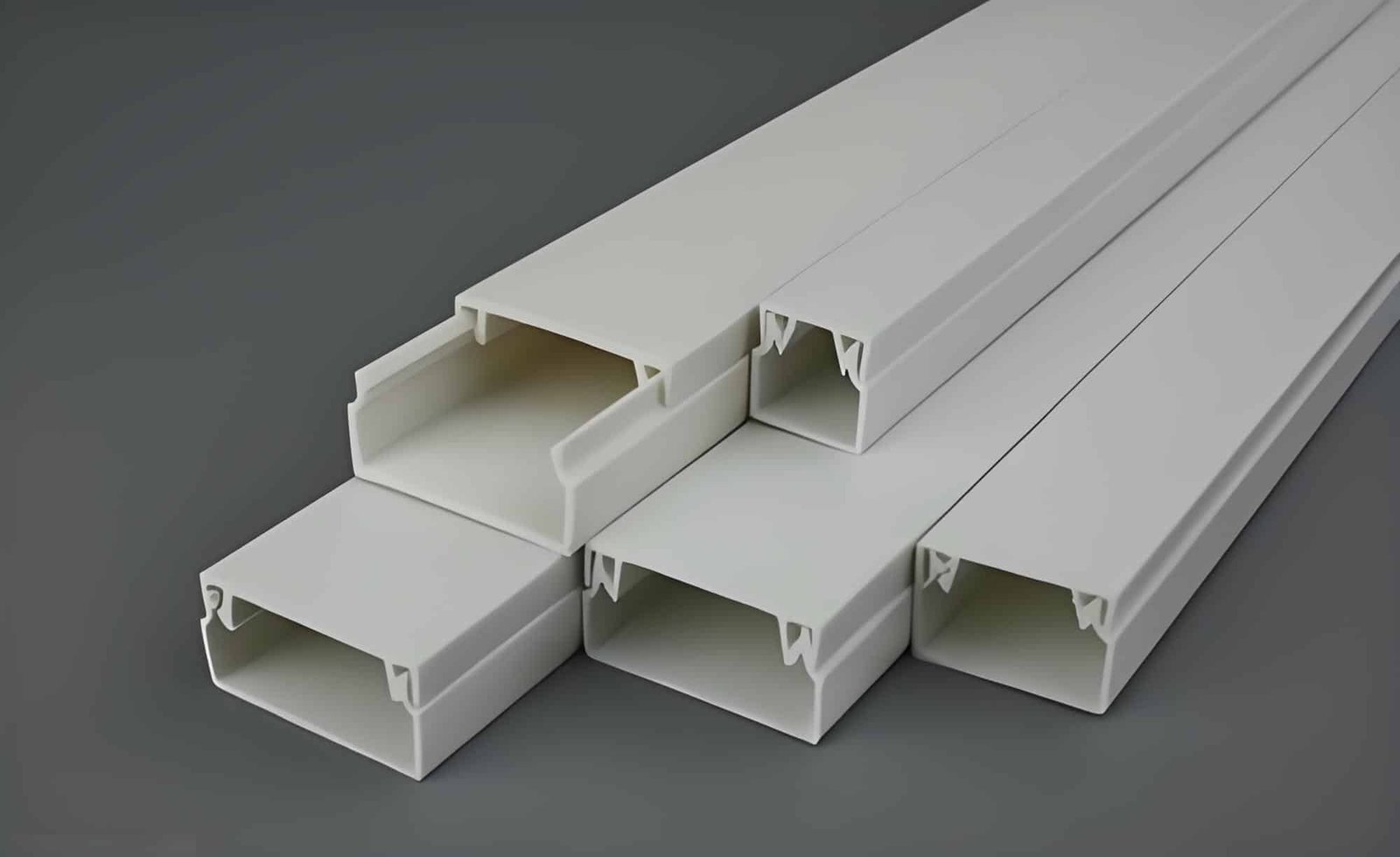
Why Dimensional Accuracy Matters in Cable Trunking
Many buyers focus on:
- Material quality
- Fire resistance
- Color consistency
- Impact strength
But dimensional accuracy often determines whether installation succeeds.
Poor dimensional control can cause:
- Visible gaps
- Uneven cover fit
- Misaligned joints
- Installation delays
- Increased labor costs
- Customer complaints
For large modular office projects, tolerance control is often more important than material cost differences.
Why 3-Meter Cable Trunking Is More Challenging Than Short Profiles
A 100 mm sample can appear perfect.
A 3-meter profile presents completely different challenges.
As profile length increases:
- Cooling shrinkage accumulates
- Internal stress increases
- Straightness becomes harder to control
- Warpage becomes more visible
This is why experienced PVC cable trunking manufacturers evaluate full-length profiles rather than short laboratory samples.
Understanding Dimensional Tolerance in Cable Trunking
Dimensional tolerance refers to the allowable deviation from the target dimension.
Example:
Target width:
100.00 mm
Tolerance:
±0.30 mm
Acceptable range:
99.70 mm to 100.30 mm
The same principle applies to:
- Height
- Wall thickness
- Cover dimensions
- Locking features
- Divider geometry
Why Perfect Dimensions Are Physically Impossible
Many buyers ask:
“Can the trunking be exactly 100.00 mm?”
The practical answer is no.
Every extrusion process contains natural variation caused by:
- Material flow
- Temperature changes
- Die expansion
- Cooling behavior
- Haul-off speed variation
The goal is not perfection.
The goal is predictable and controlled variation.


How Die Thermal Expansion Affects Cable Trunking Dimensions
One of the most overlooked causes of dimensional variation is die thermal expansion.
What Happens During Extrusion?
The extrusion die may operate at:
- 170°C
- 180°C
- 190°C
- 200°C
depending on the formulation.
Steel expands as temperature rises.
As the die heats up:
- Internal openings change slightly
- Flow characteristics shift
- Profile dimensions change
This is completely normal.
Why Startup Parts Are Often Different
The first production meters may not match later production.
Until thermal equilibrium is reached:
- Dimensions fluctuate
- Surface quality varies
- Shrinkage changes
Professional PVC cable trunking factories usually discard startup material before formal production begins.
The Relationship Between PVC Shrinkage and Final Dimensions
After leaving the die, molten PVC begins cooling immediately.
As temperature decreases:
- Molecular chains contract
- Profile dimensions shrink
- Internal stress develops
The final dimension is determined by:
Final Dimension = Die Dimension – Shrinkage
The challenge is that shrinkage is never perfectly uniform.
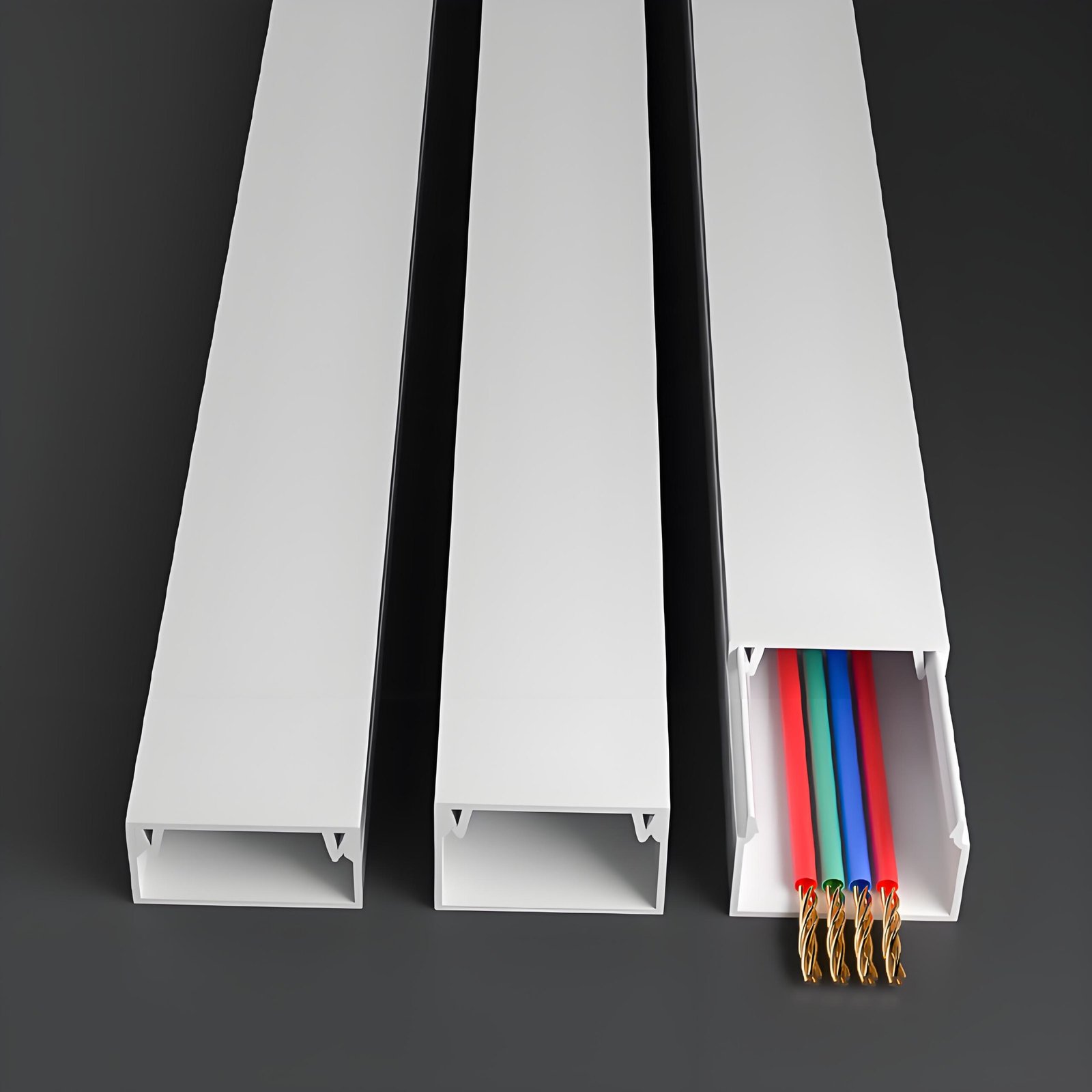
Why Cable Trunking Shrinks Unevenly
Unlike pipes, cable trunking profiles contain complex geometries.
Examples include:
- Side walls
- Internal partitions
- Snap-fit structures
- Cover locking systems
- Reinforcing ribs
Different sections cool at different rates.
This creates unequal shrinkage.
The result can be:
- Bowing
- Twisting
- Dimensional drift
What Dimensional Tolerances Are Realistic for PVC Cable Trunking?
The answer depends on profile size and application.
However, professional PVC cable trunking manufacturers generally target:
Width
±0.20 mm to ±0.50 mm
Height
±0.20 mm to ±0.50 mm
Wall Thickness
±0.10 mm to ±0.20 mm
Cover Fit Dimensions
±0.10 mm to ±0.20 mm
Length
±2 mm to ±5 mm per 3 meters
These values are considered realistic and achievable in mass production.
What Tolerance Can Modular Office Installations Accept?
For modular office projects, visual appearance becomes critical.
Most installers prefer:
Width tolerance:
±0.30 mm maximum
Height tolerance:
±0.30 mm maximum
Cover engagement dimensions:
±0.15 mm maximum
These limits help ensure seamless connections.
Why Cover Tolerance Is More Important Than Overall Width
Many buyers focus on overall profile dimensions.
However, the most critical feature is often the locking geometry.
If the cover dimensions vary by:
0.5 mm
problems may include:
- Loose lids
- Difficult installation
- Lid popping open
A professional PVC cable trunking manufacturer prioritizes functional dimensions rather than only external dimensions.
The Hidden Impact of Calibration Systems
Calibration is the heart of dimensional control.
After exiting the die, the profile enters a vacuum calibration system.
The calibrator determines:
- Shape
- Size
- Straightness
- Surface finish
Poor calibration design causes:
- Inconsistent dimensions
- Twisting
- Cover mismatch
How Professional PVC Cable Trunking Factories Control Dimensions
At SW, dimensional control begins long before production.
Step 1: Tooling Simulation
Engineers predict:
- Material flow
- Shrinkage behavior
- Cooling distribution
before manufacturing the die.
Step 2: Thermal Compensation Design
The die is intentionally designed to compensate for:
- Thermal expansion
- Material shrinkage
This improves dimensional accuracy.
Step 3: Precision Calibration
Custom calibrators stabilize the profile immediately after extrusion.
Step 4: Automated Puller Control
Consistent haul-off speed prevents dimensional fluctuation.
Step 5: Continuous Inspection
Operators measure:
- Width
- Height
- Wall thickness
- Cover dimensions
throughout production.

Why Material Formulation Influences Tolerance
Many buyers assume dimensions depend only on tooling.
Actually, formulation plays a major role.
High Filler Content
Excessive calcium carbonate may cause:
- Uneven shrinkage
- Higher warpage
- Reduced dimensional stability
Recycled Material
Mixed recycled PVC often creates:
- Variable flow characteristics
- Inconsistent shrinkage
This increases dimensional variation.
Premium PVC Compounds
High-quality formulations provide:
- Stable melt flow
- Predictable cooling
- Better dimensional consistency
Why Long Profiles Need Straightness Specifications
For 3-meter cable trunking, straightness becomes critical.
Even if width and height are correct, a bowed profile creates installation issues.
Common straightness specifications include:
Maximum bow:
1–3 mm per meter
Maximum twist:
Less than 1 degree per meter
Professional PVC cable trunking factories monitor these values carefully.
Common Causes of Gaps in Large Modular Installations
Cause 1: Length Variation
Small length differences accumulate across long runs.
Cause 2: Width Drift
Profiles no longer align correctly.
Cause 3: Cover Shrinkage
Lids fail to match the base profile.
Cause 4: Warped Profiles
Twisted sections create visible joint gaps.
Cause 5: Mixed Production Batches
Different production runs may shrink differently.
How Buyers Should Specify Cable Trunking Tolerances
Instead of requesting:
“High quality cable trunking”
specify measurable requirements.
Example:
Width:
100 mm ±0.30 mm
Height:
50 mm ±0.30 mm
Wall thickness:
2.0 mm ±0.15 mm
Length:
3000 mm ±3 mm
Straightness:
Maximum 2 mm/m
Cover engagement:
±0.15 mm
This eliminates ambiguity.
Should Buyers Request Tighter Tolerances?
Not always.
Extremely tight tolerances increase:
- Tooling cost
- Production cost
- Inspection cost
- Rejection rates
The optimal tolerance is the narrowest range that supports installation performance.
Future Trends in Precision Cable Trunking Manufacturing
The industry is moving toward:
- AI-assisted dimensional control
- Laser measurement systems
- Smart extrusion lines
- Real-time process monitoring
- Digital twin simulations
Leading PVC cable trunking manufacturers are increasingly adopting these technologies to improve consistency.

Why SW Is a Trusted PVC Cable Trunking Manufacturer
With over 20 years of extrusion expertise, SW provides:
- Custom cable trunking design
- Precision extrusion tooling
- Tight tolerance control
- Advanced formulation engineering
- Global OEM and ODM support
Our engineering team helps customers balance dimensional precision, manufacturing efficiency, and project cost.
professional PVC cable trunking manufacturers can achieve
For large-scale modular office installations, dimensional accuracy is one of the most important factors affecting installation quality.
A realistic tolerance strategy should consider:
- Die thermal expansion
- PVC shrinkage
- Calibration performance
- Straightness requirements
- Cover fit accuracy
For most high-quality projects, professional PVC cable trunking manufacturers can achieve:
- Width and height tolerances of ±0.30 mm
- Cover engagement tolerances of ±0.15 mm
- Length tolerances of ±3 mm
- Excellent straightness control
The key is not demanding impossible perfection. The key is working with an experienced PVC cable trunking factory that understands how to control every stage of the extrusion process to deliver consistent, installation-friendly cable trunking profiles across every production batch.
We have a PVC pipes factory of skilled engineers ready to support you in your product development journey from idea design to production.Any ideas about your product you can contact us freely,and our engineers will get back to you with a quote asap. Whatsapp +86 188 2072 7151
Who is Shuowei?
Since 2006, Shuowei is a professional extrusion profiles factory based in Guangdong, China. There are total about 51-100 people in our office. Shuowei PVC extrusion factory is committed to the design and production of extruded profiles, such as PVC pipes, PE trunking, PVC skirting line. Since its inception, we have won the wide recognition of the market and the deep trust of customers with our ingenious design, exquisite technology and the ultimate pursuit of quality.
Are you a manufacturer or a trader?
We are a Chinese top PVC extrusion profiles manufacturer and our factory is located in Huizhou. Our factory has a 16,000㎡ production base, 5+ automated extrusion profiles production lines, an annual production capacity of 30,000 tons, and serves more than 500 customers worldwide. Welcome to visit our factory!
What is your product range?
We pecialize in the design and production of high quality extrusion profiles,such as PVC pipe, ABS extrusion, PC lampshades, PVC skirting lines, PP trunking, PE profiles…
How long does the custom development process take?
We support custom extrusion products. The usual process has 4 steps: demand confirmation → 3D design/proofing → test certification → mass production (cycle 3-8 weeks).
Do you have any international certifications?
We have passed ISO 9001, CE, RoHS, SGS and other certifications, and meet the mainstream standards of Europe, America, the Middle East and Asia


