





In modern electrical installations, PVC trunking is more than just a cable management accessory. It directly affects installation efficiency, maintenance convenience, safety, and long-term user experience.
One of the most overlooked yet critical engineering factors in PVC cable trunking design is the locking tension of the trunking cover.
If the locking force is too weak:
- The lid pops open under cable weight
- Dust and moisture enter the trunking
- Cable organization becomes unstable
- Safety risks increase
If the locking force is too strong:
- Installers struggle to open the cover
- Maintenance becomes difficult
- Covers crack during repeated opening
- User frustration increases
For this reason, professional PVC trunking manufacturers must carefully engineer the optimal balance between:
✅ Secure locking
✅ Easy accessibility
✅ Long-term durability
✅ Repeated opening performance
As a professional PVC trunking factory with over 20 years of extrusion experience, SW has helped customers worldwide optimize trunking cover precision for commercial, industrial, and infrastructure applications.
This article explains:
- What locking tension really means
- Why PVC trunking lids fail
- How to calculate optimal locking force
- The role of geometry, material, and extrusion precision
- How professional PVC cable trunking manufacturers engineer consistent lid performance
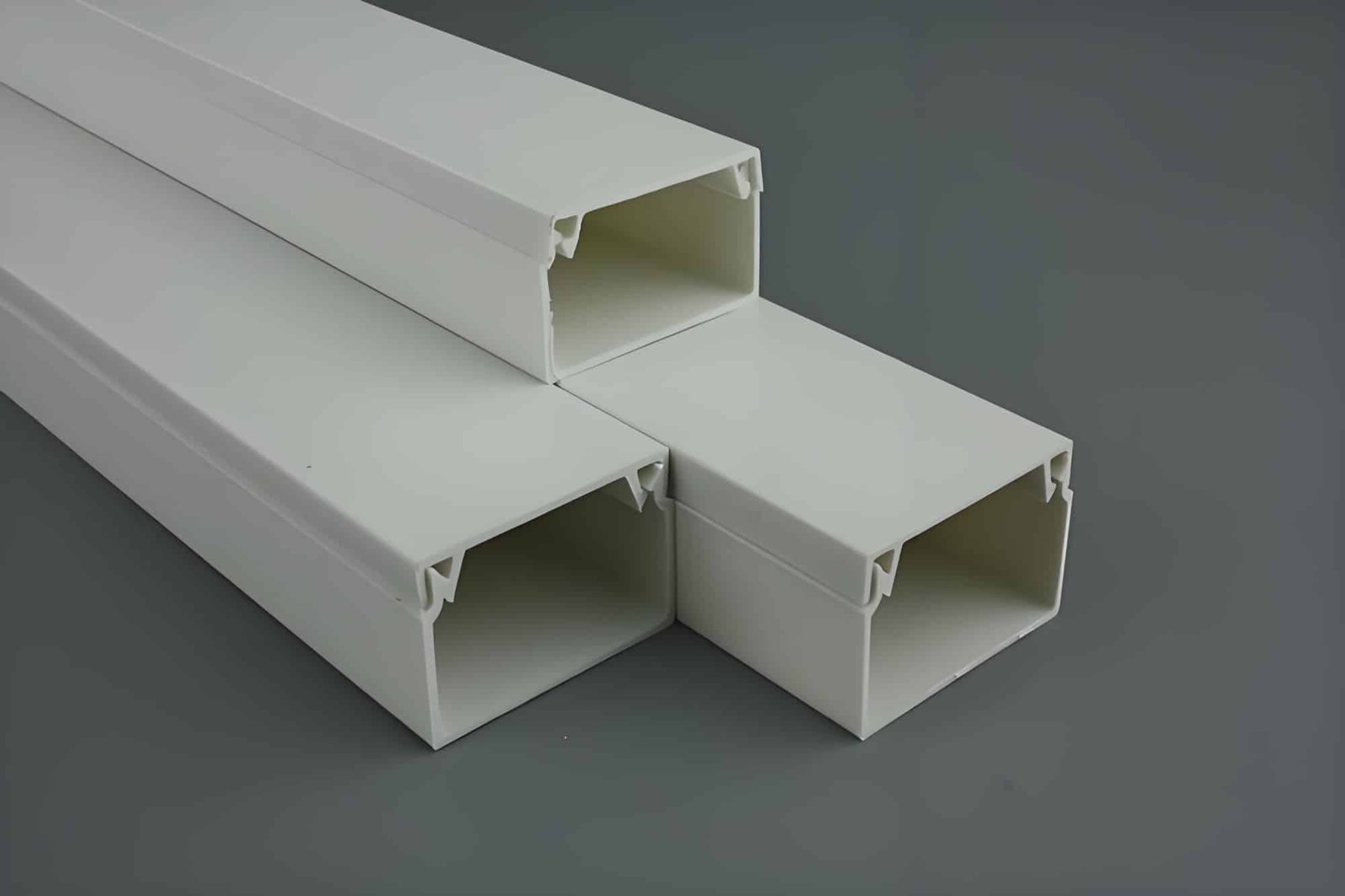
Why Locking Tension Matters in PVC Trunking
The lid system is one of the most frequently used parts of any PVC cable trunking system.
Installers may open and close the cover:
- During installation
- During maintenance
- During cable upgrades
- During inspections
Poor locking performance quickly becomes a major operational problem.
Common PVC Trunking Lid Problems
Customers commonly report:
- Covers popping open
- Loose-fitting lids
- Excessively tight locking
- Uneven engagement
- Cracking after repeated opening
These issues are usually caused by poor control of:
- Locking geometry
- Material flexibility
- Extrusion tolerances
- Cooling shrinkage
- Impact modifier balance
What Is Locking Tension in PVC Trunking?
Locking tension refers to the force required to:
- Snap the lid into position
- Keep it securely closed
- Open it when necessary
In engineering terms, it is the balance between:
- Retention force
- Accessibility force
A professional PVC cable trunking manufacturer designs this force within a controlled range.
Why Heavy Cable Weight Changes the Design Requirements
Many buyers underestimate the force generated by cables inside trunking.
Internal Cable Pressure
As cable quantity increases:
- Sidewall pressure increases
- Lid upward force increases
- Thermal expansion creates movement
Heavy cables may gradually force the lid upward.
Vibration and Movement
In industrial environments:
- Machinery vibration
- Thermal cycling
- Cable movement
can repeatedly stress the locking mechanism.
A weak lid design eventually fails.


The Engineering Goal of PVC Trunking Lid Design
The ideal PVC trunking lid should:
✅ Stay closed under maximum cable load
✅ Open without excessive force
✅ Maintain performance after repeated cycles
✅ Resist deformation over time
✅ Avoid stress cracking
Achieving all these simultaneously requires precise engineering.
Key Factors Affecting PVC Trunking Locking Tension
1. Locking Geometry
Geometry is the most important factor.
The lid locking structure usually includes:
- Hook angle
- Snap-fit depth
- Interference distance
- Contact area
Even a 0.1–0.2 mm variation can dramatically change locking force.
Hook Angle
Steeper angles:
- Increase retention force
- Increase opening difficulty
Shallower angles:
- Easier access
- Lower retention stability
Interference Fit
The lid slightly compresses during locking.
This interference creates holding force.
Too much interference:
- Excessive installation force
- Cracking risk
Too little:
- Loose lid
2. PVC Material Flexibility
The material formulation strongly affects lid behavior.
Rigid PVC vs Modified PVC
Standard rigid PVC:
- Strong
- Brittle
Impact-modified PVC:
- More flexible
- Better fatigue resistance
A professional PVC trunking factory carefully balances rigidity and flexibility.
Impact Modifiers Influence Locking Feel
Too little modifier:
- Lid becomes brittle
- Higher cracking risk
Too much modifier:
- Lid becomes soft
- Weak retention force
3. Extrusion Precision
High-quality PVC cable trunking manufacturers maintain tight tolerances.
Why Precision Matters
Small dimensional changes affect:
- Snap engagement
- Retention consistency
- Opening force
Poor extrusion control causes:
- Some lids too tight
- Some too loose
Critical Tolerance Areas
Most important dimensions include:
- Hook thickness
- Slot width
- Wall thickness
- Lid curvature
4. Cooling and Shrinkage Behavior
PVC shrinks during cooling.
Uneven cooling creates:
- Warping
- Dimensional instability
- Lid mismatch
Professional PVC trunking factories carefully control:
- Cooling tank temperature
- Haul-off speed
- Calibration tooling
5. Cable Weight Distribution
Not all cable loads behave equally.
High-Density Cable Bundles
Heavy industrial cables create:
- Constant upward force
- Long-term stress on lid
This requires stronger retention design.
Light Signal Cables
Data cable trunking may prioritize:
- Easy access
- Fast maintenance
Thus requiring lower locking tension.

How to Calculate Optimal Locking Tension
There is no universal value.
The ideal locking force depends on application requirements.
Practical Engineering Formula Concept
A simplified engineering approach considers:
Retention Force Requirement
Retention force must exceed:
- Cable upward pressure
- Vibration force
- Thermal movement force
Accessibility Force Requirement
Opening force must remain below:
- Installer ergonomic limit
- Material fatigue threshold
Practical Industry Targets
For medium-size PVC trunking:
Typical opening force range:
- 15–40 Newtons
Heavy-duty industrial trunking:
- 30–60 Newtons
Why Repeated Cycle Testing Matters
A lid that works once may fail after repeated use.
Professional PVC cable trunking manufacturers conduct:
- Open-close cycle testing
- Fatigue testing
- Long-term deformation testing
SW’s Engineering Method for PVC Trunking Lid Precision
As an experienced PVC trunking manufacturer, SW uses a multi-step engineering process.
Step 1: Define Cable Load Requirements
We evaluate:
- Cable type
- Bundle weight
- Installation orientation
Step 2: Simulate Retention Force
We analyze:
- Lid geometry
- Material elasticity
- Deflection behavior
Step 3: Prototype Testing
We produce test profiles and evaluate:
- Snap engagement
- Opening force
- Fatigue resistance
Step 4: Adjust Formula and Tooling
We optimize:
- Impact modifier ratio
- Hook geometry
- Cooling calibration
Common Mistakes in PVC Trunking Lid Design
Mistake 1: Prioritizing Tightness Only
Some suppliers make lids excessively tight to avoid complaints about looseness.
Result:
- Difficult maintenance
- Cracking during installation
Mistake 2: Excessive Filler Content
Too much CaCO₃ reduces flexibility.
This causes:
- Brittle hooks
- Reduced fatigue life
Mistake 3: Ignoring Temperature Effects
Cold environments increase PVC stiffness.
A lid perfect at 25°C may become impossible to open at -10°C.
Mistake 4: Poor Tooling Precision
Low-precision dies create inconsistent locking behavior.
How Buyers Can Specify Better PVC Trunking
Instead of simply asking for “good quality,” buyers should specify measurable requirements.
Recommended Technical Specifications
1. Opening Force Range
Example:
- 20–35N opening force
2. Retention Performance
Specify:
- No lid opening under defined cable load
3. Fatigue Durability
Example:
- Minimum 500 open-close cycles
4. Temperature Performance
Specify operating temperature range.
Why Custom PVC Trunking Design Creates Better Results
Standard designs may not suit every application.
Custom engineering allows:
- Better ergonomics
- Improved retention
- Faster installation
- Lower long-term failure rate
A professional PVC cable trunking manufacturer can tailor the design to project requirements.
Future Trends in PVC Trunking Lid Engineering
The industry is evolving toward:
- AI-assisted snap-fit simulation
- Precision co-extrusion
- Smart polymer formulations
- Fatigue-optimized geometries
High-end PVC trunking factories increasingly use advanced engineering software for lid optimization.
Why SW Is a Trusted PVC Trunking Manufacturer
SW combines:
- 20+ years of extrusion expertise
- Precision tooling capability
- Advanced PVC formulation engineering
- Custom locking system development
We help customers create PVC trunking systems that are secure, durable, and installer-friendly.

The Secret to Perfect PVC Trunking Locking Tension
The best PVC trunking design is not the tightest lid—it is the most balanced lid.
Optimal locking tension depends on:
- Geometry
- Material formulation
- Extrusion precision
- Cable load
- Environmental conditions
By carefully engineering these factors, a professional PVC cable trunking manufacturer can create trunking systems that:
✅ Stay securely closed
✅ Remain easy to access
✅ Resist fatigue and cracking
✅ Perform reliably for years
Working with an experienced PVC trunking factory like SW ensures that your custom trunking design achieves the ideal balance between performance and usability.
We have a PVC pipes factory of skilled engineers ready to support you in your product development journey from idea design to production.Any ideas about your product you can contact us freely,and our engineers will get back to you with a quote asap. Whatsapp +86 188 2072 7151
Who is Shuowei?
Since 2006, Shuowei is a professional extrusion profiles factory based in Guangdong, China. There are total about 51-100 people in our office. Shuowei PVC extrusion factory is committed to the design and production of extruded profiles, such as PVC pipes, PE trunking, PVC skirting line. Since its inception, we have won the wide recognition of the market and the deep trust of customers with our ingenious design, exquisite technology and the ultimate pursuit of quality.
Are you a manufacturer or a trader?
We are a Chinese top PVC extrusion profiles manufacturer and our factory is located in Huizhou. Our factory has a 16,000㎡ production base, 5+ automated extrusion profiles production lines, an annual production capacity of 30,000 tons, and serves more than 500 customers worldwide. Welcome to visit our factory!
What is your product range?
We pecialize in the design and production of high quality extrusion profiles,such as PVC pipe, ABS extrusion, PC lampshades, PVC skirting lines, PP trunking, PE profiles…
How long does the custom development process take?
We support custom extrusion products. The usual process has 4 steps: demand confirmation → 3D design/proofing → test certification → mass production (cycle 3-8 weeks).
Do you have any international certifications?
We have passed ISO 9001, CE, RoHS, SGS and other certifications, and meet the mainstream standards of Europe, America, the Middle East and Asia


