




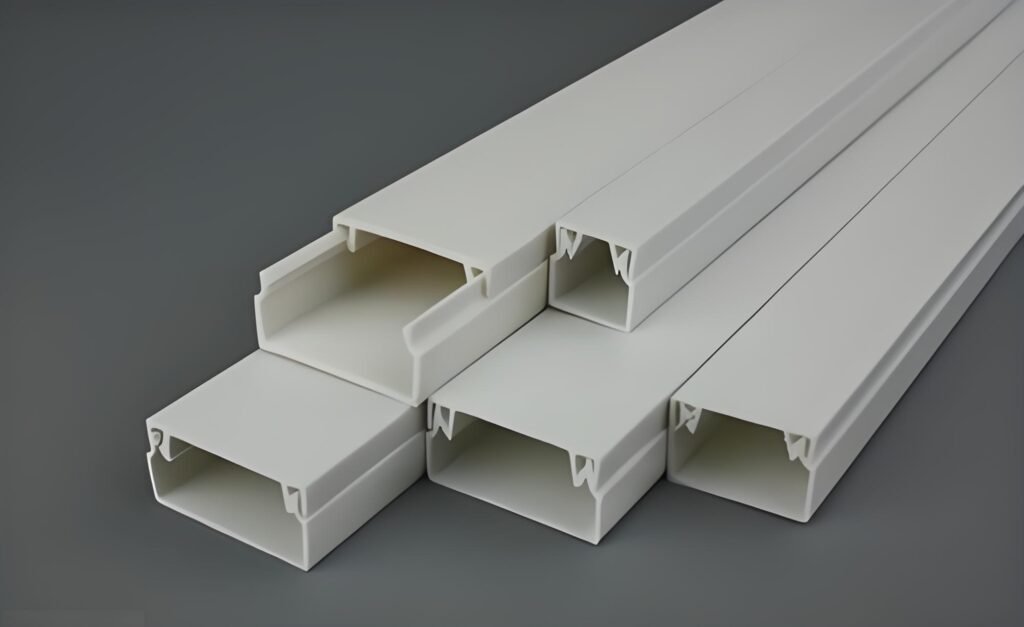
In many global construction and electrical installation projects, PVC trunking is selected because of its affordability, flame resistance, lightweight structure, and easy installation. From commercial office buildings to industrial electrical systems, high-quality PVC cable trunking plays a critical role in protecting and organizing wiring systems.
However, one recurring problem appears in cold-weather regions:
The PVC trunking looks normal in the warehouse, but during winter installation, it suddenly cracks, splinters, or even shatters when cut, drilled, or snapped into place.
This issue is especially common in:
- Northern Europe
- Canada
- Russia
- High-altitude mountain regions
- Cold-storage facilities
- Winter construction environments
For buyers and contractors, this creates major problems:
- Installation delays
- Product returns
- Safety concerns
- Increased labor costs
- Customer complaints
As a professional PVC trunking factory with more than 20 years of extrusion experience, SW has helped many global clients solve cold-weather brittleness problems through custom impact-modified PVC formulations.
This article explains:
- Why PVC trunking becomes brittle in cold weather
- What impact modifiers actually do
- How to specify the correct modifier ratio
- How to balance impact resistance, cost, and extrusion stability
- How professional PVC cable trunking manufacturers engineer reliable cold-weather performance

Why PVC Trunking Becomes Brittle in Cold Weather
To understand the solution, buyers first need to understand the material behavior of PVC.
PVC Is Naturally Rigid at Low Temperatures
Rigid PVC (uPVC) is widely used in PVC trunking because of its:
- Structural rigidity
- Flame retardancy
- Electrical insulation
- Dimensional stability
However, standard rigid PVC has a major weakness:
👉 Its impact resistance decreases sharply as temperature drops.
The “Glass Transition” Problem in PVC Trunking
PVC contains polymer chains that move less freely at low temperatures.
As temperature decreases:
- Molecular mobility drops
- Material stiffness increases
- Energy absorption decreases
Eventually, the material transitions into a more brittle state.
This means that a PVC cable trunking product that performs perfectly at 25°C may crack easily at -10°C.
Why Some PVC Trunking Cracks More Easily Than Others
Not all PVC trunking manufacturers use the same formula.
Cold-weather performance depends heavily on:
- PVC resin quality
- Filler ratio
- Stabilizer package
- Processing conditions
- Impact modifier type and dosage
Low-cost products often reduce expensive impact modifiers to lower production costs.
Common Symptoms of Cold-Weather PVC Trunking Failure
Customers frequently report:
- Cracking during screw installation
- Shattering while cutting
- Brittle snap-fit lids
- Corner fractures during bending
- Breakage during transportation in winter
These are classic signs of insufficient low-temperature impact resistance.
What Are Impact Modifiers in PVC Trunking?
Impact modifiers are additives designed to improve toughness.
A professional PVC cable trunking manufacturer uses them to help PVC absorb sudden mechanical stress without cracking.
How Impact Modifiers Work
Impact modifiers create microscopic elastic regions inside the PVC matrix.
When impact occurs:
- Stress energy disperses
- Crack propagation slows
- Material deforms instead of shattering
Without modifiers, cracks spread rapidly through rigid PVC.
Which Impact Modifiers Work Best for PVC Trunking?
Different modifier systems provide different performance.
1. CPE (Chlorinated Polyethylene)
CPE is one of the most common modifiers used in PVC trunking.
Advantages
- Good low-temperature toughness
- Cost-effective
- Improves processing stability
Limitations
- Excessive use may reduce rigidity
- Surface finish can worsen
Typical Ratio
Most PVC cable trunking factories use:
- 5–12 phr (parts per hundred resin)
depending on required performance.
2. Acrylic Impact Modifiers (AIM)
Acrylic modifiers are premium solutions.
Advantages
- Excellent weather resistance
- Better surface quality
- Strong impact performance
Best Applications
- High-end PVC trunking
- Outdoor cable management
- Cold-climate installations
Typical Ratio
- 4–10 phr
3. MBS Impact Modifiers
MBS (Methacrylate-Butadiene-Styrene) offers high transparency and toughness.
Advantages
- Excellent impact resistance
Limitations
- Poor UV resistance outdoors
Not ideal for outdoor PVC cable trunking unless UV stabilized.


How Much Impact Modifier Does PVC Trunking Actually Need?
This is the most important engineering question.
There Is No Universal Ratio
The ideal modifier ratio depends on:
- Installation temperature
- Product thickness
- Filler content
- UV exposure
- Mechanical loading
- Required rigidity
A professional PVC trunking factory customizes formulations for each project.
General Industry Guidelines
Mild Climate PVC Trunking
Installation above 10°C:
- 4–6 phr modifier may be sufficient
Moderate Cold Weather
Installation around 0°C to -10°C:
- 6–9 phr recommended
Extreme Cold Regions
Installation below -20°C:
- 8–14 phr premium modifier system often required
Why Cheap PVC Trunking Fails in Winter
Many low-cost suppliers reduce modifier dosage because impact modifiers are expensive.
Instead, they increase:
- Calcium carbonate filler
- Recycled PVC content
This lowers production cost but creates brittle products.
The Hidden Interaction Between Fillers and Impact Modifiers
This is a critical but often overlooked issue.
High Calcium Carbonate Reduces Toughness
Excess filler creates rigid points inside the PVC structure.
Even with modifiers present:
- Crack propagation accelerates
- Brittleness increases
Recycled PVC Makes Modifier Performance Less Effective
Recycled material already has degraded polymer chains.
As a result:
- More modifier is needed
- Performance consistency drops
A professional PVC cable trunking manufacturer balances all these variables carefully.
How SW Engineers Cold-Resistant PVC Trunking
As an experienced PVC trunking manufacturer, SW develops formulations based on actual climate conditions.
Step 1: Define Installation Temperature
We ask customers:
- Minimum installation temperature
- Indoor or outdoor use
- Transportation conditions
Step 2: Analyze Mechanical Requirements
Different projects require different properties:
- Flexibility
- Rigidity
- Snap-fit strength
- Screw retention
Step 3: Optimize Impact Modifier Ratio
SW balances:
- Toughness
- Cost
- Extrusion stability
- Surface quality
Step 4: Conduct Low-Temperature Testing
We test products under simulated cold environments.
Typical tests include:
- Drop impact testing
- Cold bending tests
- Brittleness temperature testing
Why Too Much Impact Modifier Can Also Be a Problem
More modifier is not always better.
Excess Modifier Can Cause
- Reduced stiffness
- Surface waviness
- Extrusion instability
- Higher shrinkage
- Increased cost
The best formula is a balanced formula.
Recommended Custom Formula Strategy for PVC Trunking
For most cold-weather PVC cable trunking projects, SW recommends:
Balanced Cold-Weather Formula
- High-quality virgin PVC resin
- Moderate CaCO₃ filler level
- Premium CPE or acrylic modifier
- UV stabilizer package
- Controlled processing aids
This provides:
- Good toughness
- Stable extrusion
- Long-term reliability
How Buyers Can Specify Better PVC Trunking
Instead of only asking for “stronger trunking,” buyers should specify:
Recommended Technical Questions
1. What Is the Brittleness Temperature?
Ask for actual testing data.
2. What Impact Modifier System Is Used?
CPE? Acrylic? Hybrid?
3. What Is the Modifier Ratio?
A reliable PVC trunking factory should provide a range.
4. Is Recycled PVC Used?
This strongly affects cold performance.
5. What Low-Temperature Testing Was Conducted?
Ask for impact test conditions.
Real Project Case from SW
A Northern European customer experienced severe cracking during winter installation.
The original supplier used:
- High filler loading
- Low modifier dosage
SW redesigned the formula:
- Reduced filler content
- Increased acrylic impact modifier
- Improved processing stability
Results
- No cracking at -15°C installation
- Improved lid flexibility
- Lower warranty claims
- Better installer satisfaction
Future Trends in PVC Trunking Formulation
The industry is evolving toward:
- Advanced acrylic modifiers
- Nano-impact systems
- Hybrid toughening technology
- AI-assisted formulation optimization
High-performance PVC cable trunking manufacturers are increasingly engineering climate-specific compounds.
Why SW Is a Trusted PVC Trunking Manufacturer
SW combines:
- 20+ years of extrusion expertise
- Advanced formulation engineering
- Custom cold-weather solutions
- Global project experience
We help customers build reliable PVC trunking systems for demanding environments.
How to Prevent PVC Trunking from Shattering in Cold Weather
Cold-weather cracking is not random—it is usually a formulation problem.
The key factors are:
- Correct impact modifier type
- Proper modifier ratio
- Controlled filler content
- High-quality raw materials
- Professional extrusion control
For most projects, a properly engineered modifier system dramatically improves low-temperature performance.
Working with an experienced PVC cable trunking manufacturer like SW ensures that your PVC trunking remains durable, safe, and installation-friendly even in harsh winter conditions.
We have a PVC pipes factory of skilled engineers ready to support you in your product development journey from idea design to production.Any ideas about your product you can contact us freely,and our engineers will get back to you with a quote asap. Whatsapp +86 188 2072 7151
Who is Shuowei?
Since 2006, Shuowei is a professional extrusion profiles factory based in Guangdong, China. There are total about 51-100 people in our office. Shuowei PVC extrusion factory is committed to the design and production of extruded profiles, such as PVC pipes, PE trunking, PVC skirting line. Since its inception, we have won the wide recognition of the market and the deep trust of customers with our ingenious design, exquisite technology and the ultimate pursuit of quality.
Are you a manufacturer or a trader?
We are a Chinese top PVC extrusion profiles manufacturer and our factory is located in Huizhou. Our factory has a 16,000㎡ production base, 5+ automated extrusion profiles production lines, an annual production capacity of 30,000 tons, and serves more than 500 customers worldwide. Welcome to visit our factory!
What is your product range?
We pecialize in the design and production of high quality extrusion profiles,such as PVC pipe, ABS extrusion, PC lampshades, PVC skirting lines, PP trunking, PE profiles…
How long does the custom development process take?
We support custom extrusion products. The usual process has 4 steps: demand confirmation → 3D design/proofing → test certification → mass production (cycle 3-8 weeks).
Do you have any international certifications?
We have passed ISO 9001, CE, RoHS, SGS and other certifications, and meet the mainstream standards of Europe, America, the Middle East and Asia


