





As modern buildings become increasingly connected, the amount of electrical wiring, network cables, fiber optics, security systems, automation controls, and power distribution infrastructure continues to grow rapidly. Whether in data centers, hospitals, smart factories, airports, commercial buildings, or telecommunications facilities, engineers face a common challenge:How can strong-current and weak-current cables be routed together inside the same cable trunking system without causing electromagnetic interference (EMI)?
Traditionally, metal dividers or metallic cable trays have been used to reduce electromagnetic coupling between power and signal circuits. However, metal solutions introduce several disadvantages:
- Higher material cost
- Increased installation weight
- Corrosion concerns
- Grounding requirements
- More complicated manufacturing
- Reduced design flexibility
As a professional PVC cable trunking manufacturer with more than 20 years of extrusion experience, SW has helped customers worldwide develop custom multi-compartment cable trunking systems that effectively reduce EMI while maintaining the cost, flexibility, and installation advantages of plastic extrusion.
This article explains how engineers can design custom cable trunking systems that minimize electromagnetic interference without relying on metal dividers, while maintaining excellent cable management, safety, and long-term reliability.

Understanding EMI in Cable Trunking Systems
Before designing a better cable trunking system, it is important to understand how EMI occurs.
Electromagnetic interference is generated whenever electrical current flows through a conductor.
Common EMI sources include:
- Power cables
- Motor drives
- HVAC equipment
- Variable frequency drives (VFD)
- UPS systems
- Power distribution units
- High-current industrial equipment
These sources generate electromagnetic fields that may interfere with nearby:
- Ethernet cables
- Fiber converters
- Audio systems
- Security systems
- Fire alarm circuits
- Industrial control wiring
- Data communication networks
In many facilities, both power and signal cables must coexist inside the same PVC cable trunking infrastructure.
Without proper separation, performance problems can occur.
Why EMI Is Becoming a Bigger Problem
Modern buildings contain more electronics than ever before.
Examples include:
- Smart building systems
- IoT networks
- PoE devices
- Building automation controls
- High-speed data transmission
- Security surveillance systems
Many of these systems operate using low-voltage signals that are highly sensitive to interference.
As data speeds increase from:
- 1 Gigabit
- 10 Gigabit
- 40 Gigabit
- 100 Gigabit
signal integrity becomes increasingly important.
This means that proper cable trunking design is no longer optional.


Why Metal Dividers Are Not Always the Best Solution
Many engineers automatically specify metal partitions.
However, metal dividers introduce new challenges.
Increased Manufacturing Cost
Metal inserts increase:
- Material costs
- Assembly costs
- Inventory complexity
Additional Grounding Requirements
Metal components often require:
- Electrical bonding
- Grounding verification
- Compliance documentation
Weight Increase
Metal partitions significantly increase system weight.
This can affect:
- Shipping costs
- Installation labor
- Structural loading
Corrosion Risks
In humid environments:
- Galvanic corrosion
- Surface oxidation
- Grounding degradation
may occur over time.
For these reasons, many modern projects seek plastic-based EMI mitigation strategies.
The First Principle: Physical Separation Is More Important Than Metal
One of the most misunderstood aspects of EMI control is that distance often provides greater benefits than shielding.
Electromagnetic field strength decreases rapidly with increasing distance.
Therefore, a properly engineered multi-compartment cable trunking design can significantly reduce interference without metal barriers.

Designing Multi-Compartment Cable Trunking
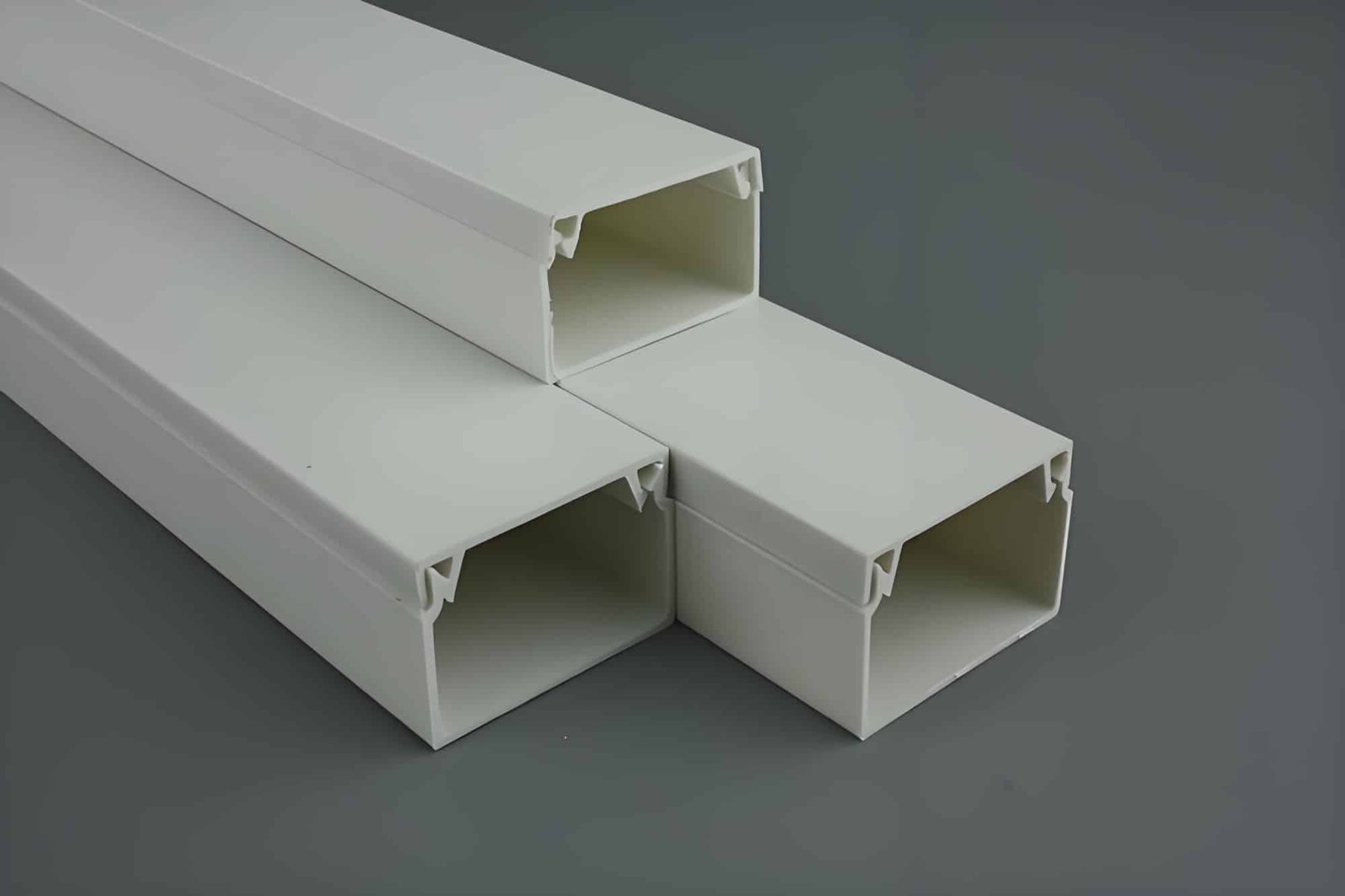
The most effective solution is often a custom multi-compartment profile.
Instead of one large cavity, the cable trunking contains multiple separated channels.
For example:
Compartment 1:
Power cables
Compartment 2:
Control wiring
Compartment 3:
Network cables
Compartment 4:
Fiber optics
Each cable category remains isolated.
Determining the Number of Compartments
A professional PVC cable trunking factory should evaluate:
- Cable types
- Current levels
- Data transmission requirements
- Installation density
Typical configurations include:
Two-Compartment Cable Trunking
Used for:
- Power and data separation
Three-Compartment Cable Trunking
Used for:
- Power
- Control
- Communication
Four-Compartment Cable Trunking
Used for:
- High-density data centers
- Industrial automation facilities
Internal Wall Geometry Matters
The divider geometry significantly affects EMI performance.
A common mistake is using thin divider walls.
Thin walls may:
- Vibrate
- Deform
- Allow cable crossover
Instead, a professional PVC cable trunking manufacturer should design reinforced divider structures.
Recommended features include:
- Ribbed partitions
- Structural reinforcement
- Anti-deflection walls
- Controlled wall thickness
Increasing Air Gap Distance
Distance remains one of the most powerful EMI mitigation methods.
The divider should not simply separate cables.
It should maximize spacing between cable groups.
Design techniques include:
- Offset compartments
- Raised channels
- Staggered cable paths
These approaches reduce electromagnetic coupling.
Vertical Separation vs Horizontal Separation
Most standard PVC cable trunking systems use horizontal partitions.
However, vertical separation may provide superior performance.
Benefits include:
- Greater physical distance
- Reduced cable crossing
- Better airflow
- Easier maintenance
Custom extrusion dies can integrate vertical partition designs directly into the profile.

Using Specialized PVC Compounds
Although standard PVC provides electrical insulation, advanced compounds can improve performance.
Options include:
- Carbon-modified compounds
- Antistatic compounds
- Conductive outer layers
- Hybrid PVC formulations
These materials can help control unwanted electrical effects.
The Role of Cable Placement
Even the best cable trunking design can fail if installers place cables incorrectly.
Best practices include:
Power Cables
Place in outer compartments.
Data Cables
Place in isolated compartments.
Fiber Optics
Use dedicated channels.
Control Wiring
Separate from high-current conductors.
Proper installation remains essential.
Lid Design Can Affect EMI Performance
Many engineers overlook lid design.
A poorly fitting cover may allow:
- Cable migration
- Bundle crossover
- Compartment contamination
A custom PVC cable trunking manufacturer should design:
- Secure locking systems
- Tight compartment alignment
- Controlled lid engagement
to preserve cable separation.
Why Data Centers Need Specialized Cable Trunking
Data centers represent one of the most demanding environments.
A typical rack row may contain:
- Power feeds
- UPS connections
- Fiber trunks
- High-speed Ethernet
- Monitoring cables
Mixing these systems without proper separation can increase signal integrity risks.
Custom multi-compartment cable trunking provides a practical solution.
How SW Designs EMI-Resistant Cable Trunking
At SW, our engineering team follows a structured design process.
Step 1: Analyze Cable Types
We evaluate:
- Voltage levels
- Current loads
- Data rates
- Cable diameters
Step 2: Model Internal Layout
Our engineers create compartment arrangements that maximize separation.
Step 3: Design Structural Dividers
We optimize:
- Divider thickness
- Rib structures
- Wall stiffness
to prevent deformation.
Step 4: Prototype and Test
We manufacture sample PVC cable trunking profiles and evaluate:
- Cable capacity
- Installation convenience
- Dimensional stability
- Divider effectiveness
Step 5: Production Optimization
Our extrusion team ensures:
- Consistent dimensions
- Stable cooling
- Accurate partition geometry
across mass production.
Common Mistakes When Designing Multi-Compartment Cable Trunking
Mistake 1: Using Compartments That Are Too Small
Overfilled compartments increase interference risk.
Mistake 2: Ignoring Future Expansion
Always reserve space for additional cables.
Mistake 3: Thin Internal Dividers
Weak dividers may deform during installation.
Mistake 4: No Cable Segregation Rules
Even excellent trunking cannot compensate for poor installation practices.
Mistake 5: Choosing Standard Profiles for Complex Applications
Data centers often require custom-engineered solutions.
Future Trends in EMI-Resistant Cable Trunking
The industry is moving toward:
- Smart building infrastructure
- High-density networking
- AI data centers
- Edge computing facilities
- Industrial automation
As these applications expand, custom cable trunking systems will increasingly require:
- Multi-compartment designs
- Enhanced cable management
- Advanced extrusion profiles
- Precision dimensional control

Why SW Is a Trusted PVC Cable Trunking Manufacturer
With more than 20 years of extrusion expertise, SW provides:
- Custom profile design
- Multi-compartment cable trunking development
- Precision tooling manufacturing
- Advanced PVC formulation capability
- Global OEM and ODM support
We help customers create cable trunking systems that achieve superior cable organization and EMI mitigation without relying on costly metal dividers.
The most effective way to reduce EMI in modern cable trunking systems
The most effective way to reduce EMI in modern cable trunking systems is not necessarily through metal shielding. In many applications, carefully engineered multi-compartment designs provide excellent performance while reducing cost, weight, and installation complexity.
By optimizing:
- Compartment layout
- Physical separation
- Divider geometry
- Cable routing
- Lid design
- Material selection
a custom PVC cable trunking manufacturer can create highly effective EMI-resistant solutions suitable for data centers, industrial automation, telecommunications infrastructure, hospitals, airports, and smart buildings.
For buyers seeking the ideal balance between performance, manufacturability, and cost, a professionally engineered custom multi-compartment PVC cable trunking system is often the most practical solution.
We have a PVC pipes factory of skilled engineers ready to support you in your product development journey from idea design to production.Any ideas about your product you can contact us freely,and our engineers will get back to you with a quote asap. Whatsapp +86 188 2072 7151
Who is Shuowei?
Since 2006, Shuowei is a professional extrusion profiles factory based in Guangdong, China. There are total about 51-100 people in our office. Shuowei PVC extrusion factory is committed to the design and production of extruded profiles, such as PVC pipes, PE trunking, PVC skirting line. Since its inception, we have won the wide recognition of the market and the deep trust of customers with our ingenious design, exquisite technology and the ultimate pursuit of quality.
Are you a manufacturer or a trader?
We are a Chinese top PVC extrusion profiles manufacturer and our factory is located in Huizhou. Our factory has a 16,000㎡ production base, 5+ automated extrusion profiles production lines, an annual production capacity of 30,000 tons, and serves more than 500 customers worldwide. Welcome to visit our factory!
What is your product range?
We pecialize in the design and production of high quality extrusion profiles,such as PVC pipe, ABS extrusion, PC lampshades, PVC skirting lines, PP trunking, PE profiles…
How long does the custom development process take?
We support custom extrusion products. The usual process has 4 steps: demand confirmation → 3D design/proofing → test certification → mass production (cycle 3-8 weeks).
Do you have any international certifications?
We have passed ISO 9001, CE, RoHS, SGS and other certifications, and meet the mainstream standards of Europe, America, the Middle East and Asia


