




“We have been working with Shuowei for 8 years. We choose SW plastic extrusion profiles manufacturer, their PVC trunking and profiles are our first choice for high-end office building projects. The 0.1mm dimensional tolerance control far exceeds the Japanese JIS standard, and no secondary processing is required during installation, saving 20% of construction costs. The 500-kilometer order urgently added in 2023 was delivered 5 days ahead of schedule – such execution is admirable!”
1. Why PVC Trunking Matters for Modern Electrical & Architectural Systems
As global electrical systems continue to evolve toward higher safety standards and more complex installations, PVC trunking has become a critical component for cable management, mechanical protection, and architectural integration. Today, industries such as electronics, construction, industrial automation, residential wiring, and communication infrastructure rely on PVC trunking to ensure durability, fire resistance, organization, and system reliability.
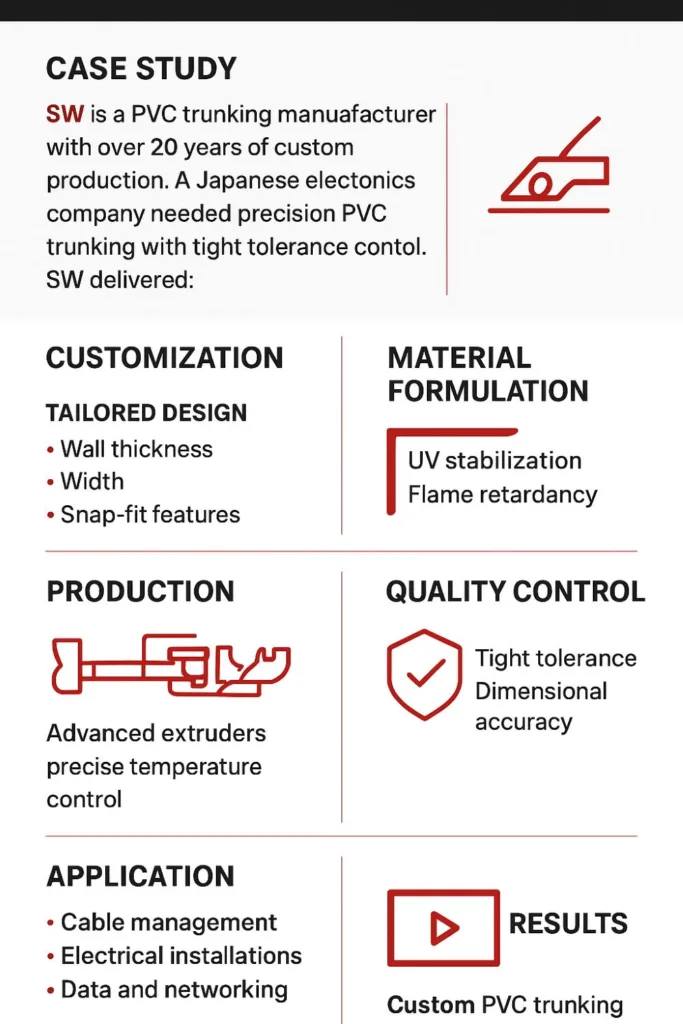
At SW, a professional plastic extrusion factory with more than 20 years of manufacturing experience, we have supported hundreds of global clients with custom PVC trunking extrusion solutions. One of our most notable collaborations was with a Japanese electrical equipment company—a customer whose standards for material tolerances, assembly fit, and appearance were among the highest in the world.
This blog provides a detailed case study of how we helped this Japanese client design, develop, and mass-produce precision PVC trunking and PVC extruded profiles, how we solved their material tolerance challenges, and why the project is now an example of our engineering capabilities in high-precision plastic extrusion manufacturing

2. Project Background — Understanding the Client’s Requirements
The Japanese company approached SW with a specific challenge:
They needed PVC trunking and custom PVC extruded profiles for electrical and communication devices that required:
Ultra-tight dimensional tolerances (±0.1–0.15 mm)
High-temperature stability
Low warpage rates across long-length profiles
Smooth surface finish with no extrusion flow marks
Consistent color matching across batches
Snap-fit assembly features requiring perfect compatibility between cover and base
RoHS and REACH compliance
They had previously worked with another supplier, but recurring tolerance variation caused:
Misfit between trunking covers and bases
Difficulty during installation
High scrap rates
Assembly inefficiency
Complaints from their downstream customers
Japan is known for extremely high demands in precision manufacturing, and the client needed a PVC trunking manufacturer capable of achieving consistent dimensional accuracy in long profiles—a challenge many factories cannot meet.
Because SW specializes in precision plastic extrusion engineering and has 20+ years of experience with PVC, ABS, PP, PE, PC, and engineering plastics, the customer selected us as the development partner.
3. Material Introduction — Choosing the Right PVC for High-Precision Trunking
For this project, SW recommended a high-stability PVC formulation specifically engineered for tight-tolerance extrusion.
Key Material Requirements
High dimensional stability
Low shrinkage rate
Excellent heat resistance
Superior smoothness and appearance
Impact resistance
Flammability compliance (depending on local standards)
Electrical insulation properties
UV stability (for models used outdoors)
Material Formula Considerations
SW customized the material using:
Premium PVC resin with low impurity content
Calcium-zinc stabilizers (environmentally friendly, used for Japanese markets)
Internal lubricants to improve melt flow consistency
External lubricants to reduce die friction
Impact modifiers for toughness
Color masterbatch with high heat stability
This formula ensured:
Tight and consistent tolerances
No yellowing during extrusion
Strong structure for snap-fit applications
Smooth surface aesthetics
Excellent processing stability during long production runs
For tight-tolerance PVC trunking, material formula stability is just as important as tooling accuracy.


4. Application Overview — Where PVC Trunking Is Used in Japan
The custom PVC trunking we manufactured is used in multiple Japanese industries:
Electrical control systems
Communication device assembly
Consumer electronics
Server room wiring
Building construction
Automated machinery interior wiring
Automotive communication units
Railway equipment
Power distribution boxes
Japan’s engineering culture emphasizes:
Reliability
Safety
Repeatability
Aesthetic harmony
Therefore, even simple PVC trunking components must meet premium-quality appearance and functional performance.
5. Design & Engineering — How SW Developed the Custom PVC Trunking
To produce PVC trunking with ultra-high precision, SW followed a structured, engineering-driven development workflow.
5.1 Understanding the Client’s Technical Drawings
The Japanese client provided:
2D drawings
3D STEP model
Material requirement sheet
Tolerance table
Assembly diagrams showing how the trunking interacts with other components
Our engineering team performed a thorough assessment focusing on:
Wall thickness uniformity
Snap-fit design
Structural load points
Expected shrinkage during cooling
Mold-flow simulation for the extrusion die
Risk of deformation
Minimum draft angles
5.2 Extrusion Mold (Die) Design
PVC trunking requires high-precision extrusion dies, and SW developed:
Calibrated die flow channel geometry
Optimized die land length
Special flow-balancing inserts
Mirror-polished die surfaces to reduce flow lines
All tooling was manufactured using German-grade tool steel, CNC precision machining, and mirror finishing.
5.3 Multi-Stage Calibration System
Because the trunking profile includes multiple internal channels, SW designed a multi-chamber vacuum calibration system, including:
Primary vacuum calibration
Secondary vacuum plates
Water cooling tanks
Straightening frame
High-precision haul-off system
This ensured the profile maintains perfect geometry during cooling.

6. The Complete Production Process — How SW Manufactures Precision PVC Trunking
Below is an overview of the PVC trunking manufacturing workflow used for the Japanese client.
6.1 Raw Material Preparation
PVC resin drying
Additive ratio verification
Batch mixing
Cooling
Masterbatch blending
6.2 Extrusion Line Setup
We used SW’s high-precision twin-screw extrusion line, equipped with:
PID temperature control
Real-time torque monitoring
Melt pressure sensors
Laser diameter and width measuring system
6.3 Extrusion Process
Melting and homogenizing
Flow through die head
Profile shaping in vacuum calibrator
Multi-stage cooling
Precision haul-off
Cutting to length
Final dimensional checking
6.4 In-line Measurement & Quality Control
Japan’s requirements are strict, so we implemented:
Laser-based dimension measurement system
Angle measurement
Wall thickness verification
Color consistency inspection
Snap-fit performance test
Bending test
Heat resistance test
6.5 Final Packaging
The client requested:
Anti-scratch film
Bubble wrap lining
Custom carton printing
Moisture-proof packaging for sea transport
7. Solving the Client’s Major Problem — Material Tolerance Inconsistency
The most challenging issue from the previous supplier was dimensional instability.
Small variations of ±0.25–0.35 mm caused:
Difficulty assembling trunking cover and base
Excessive looseness or tightness
Higher installation time
Poor appearance
Noise due to vibration (for some applications)
SW solved the tolerance issue in three engineering steps:
7.1 Step 1 — Material Formula Stabilization
We adjusted:
Plasticizer ratio
Lubricant integration
Thermal stabilizer type
Melt flow consistency
This reduced shrinkage variation during cooling.
7.2 Step 2 — Extrusion Die Optimization
We corrected the die:
Flow channel angles
Die land thickness
Edge support
Internal polishing techniques
Achieving uniform melt flow was the key to consistent dimensions.
7.3 Step 3 — Precision Cooling & Pulling Control
By optimizing:
Vacuum calibrator geometry
Cooling water temperature
Puller pressure
Haul-off speed
We achieved ±0.1 mm dimensional tolerance consistently across full production runs.
8. Client Feedback — Why the Japanese Customer Highly Praised SW
After we delivered the first full batch, the client reported:
Zero tolerance-related assembly issues
Perfect fit between cover and base
Appearance smoother than their previous supplier
Higher production efficiency during their internal assembly
Fewer defects, reducing cost
Better packaging and logistics quality
The client later expanded the order into:
Additional custom profiles
Anti-flame PVC variants
PVC/ABS composite profiles
They also introduced SW to other departments within their company, expanding our cooperation into more categories.
We have a PVC pipes factory of skilled engineers ready to support you in your product development journey from idea design to production.Any ideas about your product you can contact us freely,and our engineers will get back to you with a quote asap. Whatsapp +86 188 2072 7151
Who is Shuowei?
Since 2006, Shuowei is a professional extrusion profiles factory based in Guangdong, China. There are total about 51-100 people in our office. Shuowei PVC extrusion factory is committed to the design and production of extruded profiles, such as PVC pipes, PE trunking, PVC skirting line. Since its inception, we have won the wide recognition of the market and the deep trust of customers with our ingenious design, exquisite technology and the ultimate pursuit of quality.
Are you a manufacturer or a trader?
We are a Chinese top PVC extrusion profiles manufacturer and our factory is located in Huizhou. Our factory has a 16,000㎡ production base, 5+ automated extrusion profiles production lines, an annual production capacity of 30,000 tons, and serves more than 500 customers worldwide. Welcome to visit our factory!
What is your product range?
We pecialize in the design and production of high quality extrusion profiles,such as PVC pipe, ABS extrusion, PC lampshades, PVC skirting lines, PP trunking, PE profiles…
How long does the custom development process take?
We support custom extrusion products. The usual process has 4 steps: demand confirmation → 3D design/proofing → test certification → mass production (cycle 3-8 weeks).
Do you have any international certifications?
We have passed ISO 9001, CE, RoHS, SGS and other certifications, and meet the mainstream standards of Europe, America, the Middle East and Asia


